
Kawaii and chibi: two different things
The two words are often mixed up. Chibi describes proportions: a body two to three heads tall. Kawaii describes an impression: cuteness, roundness, innocence. You can draw a chibi that is not kawaii at all, with a hard gaze and angular features. You can also draw a normal-sized character with a perfectly kawaii face.
This distinction changes the method. If you are looking for body proportions, head height, and elements to remove, read comment dessiner un chibi first. Here, we are working on the face and the vibe, meaning what makes the reader say "how cute" before even understanding why.
A starting tip: work on a front-facing face, using a simple grid. It is the most readable, and it is the one used by the beginner tutorials listed in our dessin manga facile guide.
Setting 1 and 2: a round face, large and low eyes
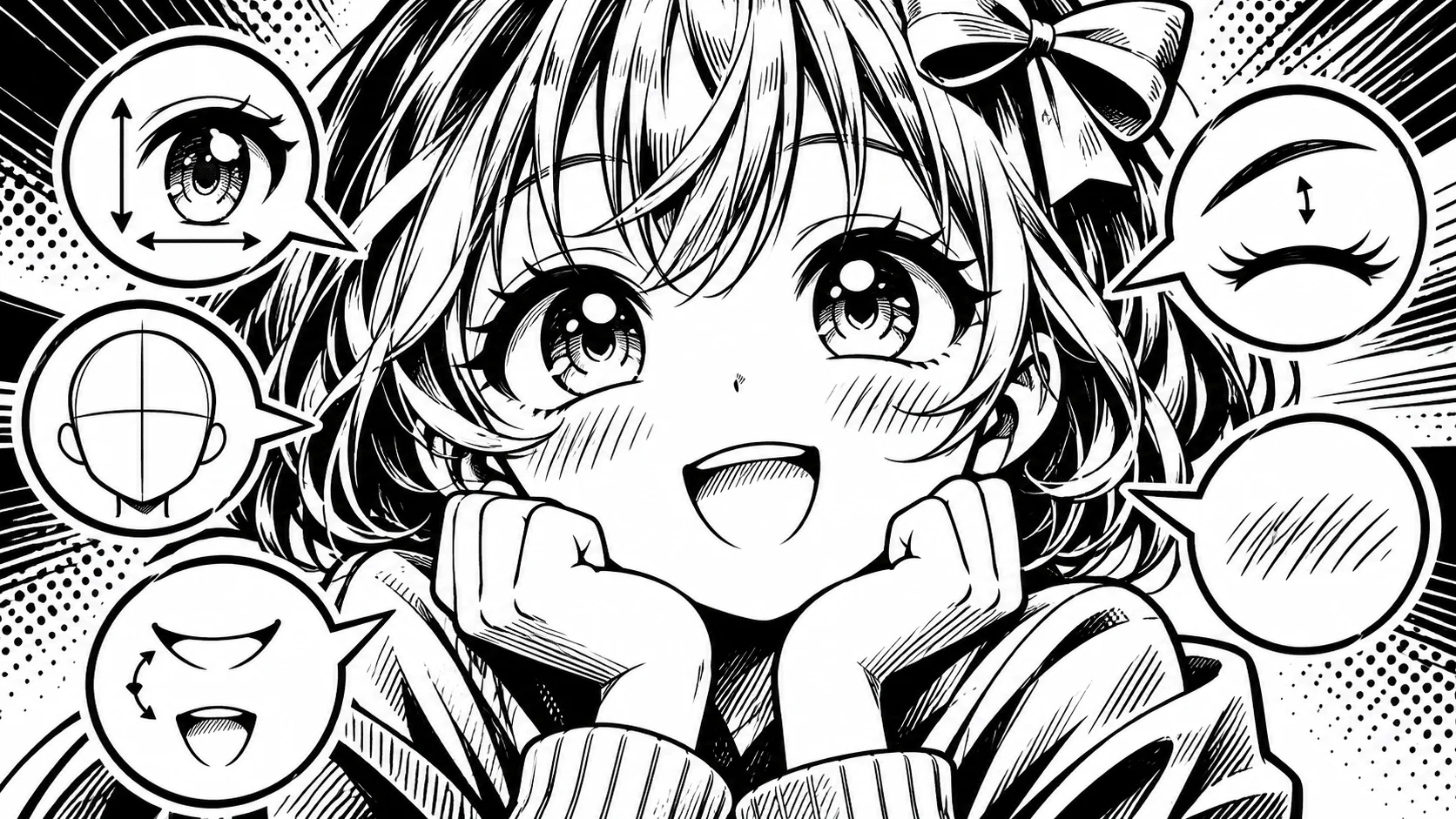
The first setting is the shape. A kawaii face is a wide circle or a short oval, with a small, rounded chin. A pointy chin, a strong jawline, or prominent cheekbones immediately steer the character toward an older look. If your drawing feels too serious, start by shortening the chin.
The second setting is the eye position. On a kawaii face, the eye line drops below the middle of the head. This leaves a large forehead, and the forehead gives a baby-like effect. The eyes themselves are large, but above all they are legible: a large dark pupil, one or two white reflection spots, an upper outline thicker than the lower one.
- A single reflection, placed at the top: a simple, honest gaze.
- One large and one small reflection: a bright, more lively gaze.
- No reflection: a blank gaze, to be avoided for cute art.
Keep a gap between the eyes at least equal to the width of one eye. Eyes that are too close together give a worried look. The complete method is in dessiner des yeux manga, and pupil management is in pupille manga.
Setting 3 and 4: reducing the nose and mouth, caring for the cheeks
The third adjustment goes against instinct: to make a face more expressive, you remove details. The nose becomes a small line or a simple dot, sometimes nothing at all. The mouth remains small, placed quite low, shaped like a "w", a small arc, or an "o". A wide mouth, with detailed lips and teeth, destroys the balance and pushes the drawing toward realism.
For nose shapes and placement, see manga nose, and for mouths drawing a manga mouth. The principle remains the same: fewer lines, but better placed.
The fourth adjustment concerns the cheeks. Two or three oblique hatch marks under the eyes, or a lighter spot of color, are enough to add warmth. They also serve to show embarrassment or joy without changing the mouth. The four ways to draw them are detailed in manga blush.
Watch out for the amount. A very heavy blush on an already busy face creates a doll-like effect. If the eyes are large and shiny, keep the cheeks subtle.
Adjustment 5: A soft palette and a single accessory
The final adjustment is the one people forget when drawing in pencil: color. Kawaii relies on light, low-saturation tones, such as pale pink, sky blue, mint, or cream. Limit yourself to three main colors, plus the black of the lines. A fourth bright color, used as a small accent, draws the eye without breaking the softness.
To apply these colors cleanly, with a base, shadow, and highlight, follow the layering method in color manga drawing.
Then add a single cute accessory: a bow, cat ears, a hair clip, a scarf. Two or three accessories clutter the silhouette and the character loses its identity. If you want to take the animal aspect further, the guide for drawing a manga cat gives four simple shapes that translate into ears, a tail, or a plush toy.
An exercise to validate everything: Three versions of the same face
To check that you have mastered the adjustments, draw the same character three times on the same sheet of paper. The first version is realistic, with a detailed nose and normal mouth. The second applies adjustments 1 and 2: round face, low and shiny eyes. The third applies all five adjustments.
Compare them from a meter away. The difference in tone should be immediately apparent. If the third version just looks smaller rather than softer, go back to the eyes: it is almost always the lack of a reflection or the eye line being too high that causes the block.
For a female body that remains consistent with this face, review the guidelines in manga girl drawing.
If you want to test these choices on a whole story without drawing every panel, Bulle lets you create characters from photos and choose from over 20 art styles. It's a way to see your kawaii character in a full page before redrawing it by hand.
Conclusion
A kawaii manga drawing comes down to five settings: a round face with a short chin, large low-placed eyes with highlights, a reduced nose and mouth, subtle cheeks, followed by a soft palette and a single accessory. Apply them one by one, in this order, and check the result each time with the three-versions exercise. For body proportions, the logical next step is the chibi guide, and for a complete page, the guide to drawing a manga from A to Z. To test your characters in a full story, see Bulle.