
Understanding the reading direction of a manga page
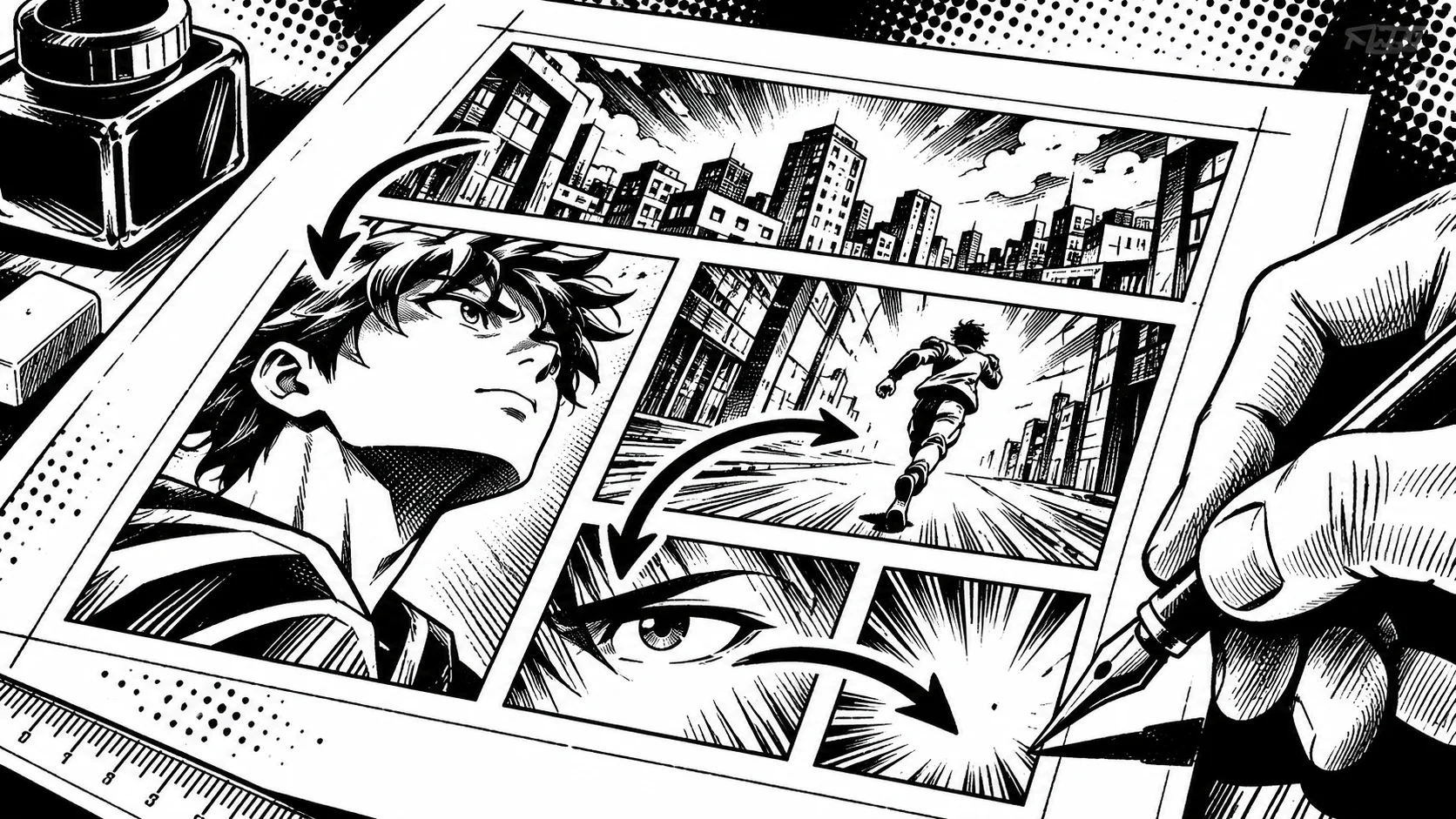
A Japanese manga is read from right to left. On the page, the eye starts from the top right corner and moves down to the bottom left corner, following the panels line by line.
Everything you draw must respect this path. A speech bubble placed to the left of a panel is read after the one on the right: if the order is reversed, the dialogue no longer makes sense.
- Place the first speech bubble in the top right of the panel.
- Have the characters face in the reading direction.
- Avoid two panels touching without a margin: the gaze no longer knows where to go.
Panel layout: pacing before drawing
Before drawing, make a small sketch of the entire page: generally four to six panels of different sizes. A large panel marks a strong moment; several small panels speed up the action.
Keep the space between the panels (the gutter) consistent. A wider space creates a pause, a reduced space gives speed. To go further, read our guide on panels and transitions and the one on paneling, from classic boards to web formats.
Placing speech bubbles and sound effects without breaking the image
Speech bubbles are drawn early, not at the end. Reserve their space in the sketch: a bubble added as an afterthought often hides the face or the action.
Short text is read quickly. If the scene is powerful, sometimes let the panel speak for itself: our silent pages show how. For text clarity, see also speech bubbles.
The 5 steps to finish a page
- Write what needs to happen on the page in one or two sentences.
- Sketch the breakdown small, with the reading direction.
- Place the speech bubbles and sound effects in the sketch.
- Draw the panels in pencil, then ink them.
- Read the page aloud, from right to left: if you hesitate, the reader will hesitate.
How many pages for a story?
There is no single correct number. On the Bulle homepage, the featured public projects range from 8 pages (a short story) to 68 pages (a long story). A short format is a good start: you finish, you learn, you start again.
If manual drawing holds you back, a tool can produce the pages for you: on Bulle, a manga project costs 500 credits, and the Beginner pack at €19.90 (2,000 credits) covers 4 complete projects. See how to create a manga with Bulle.
Conclusion
A good manga page is one that reads effortlessly: a respected reading direction, a measured pace, well-placed speech bubbles. Start with one page, reread it from right to left, fix what catches. Regularity will do the rest.