Placing the Eyes Before Drawing Them
A well-drawn eye in the wrong place is still a bad eye. Before making any strokes, draw a horizontal line across the middle of the head: this is the eye line. In manga, it is often lowered just beneath the middle, which creates a larger forehead and a younger look.
The spacing follows a simple rule: between the two eyes, leave the width of one eye. Closer together, the character appears harsh or cross-eyed. Further apart, they look naive. This is a matter of personality as much as proportion.
Keep these two light pencil guidelines on all your drawings. They also help maintain the same construction from one page to the next, a point detailed in eye consistency.
The Five Shapes, in This Order
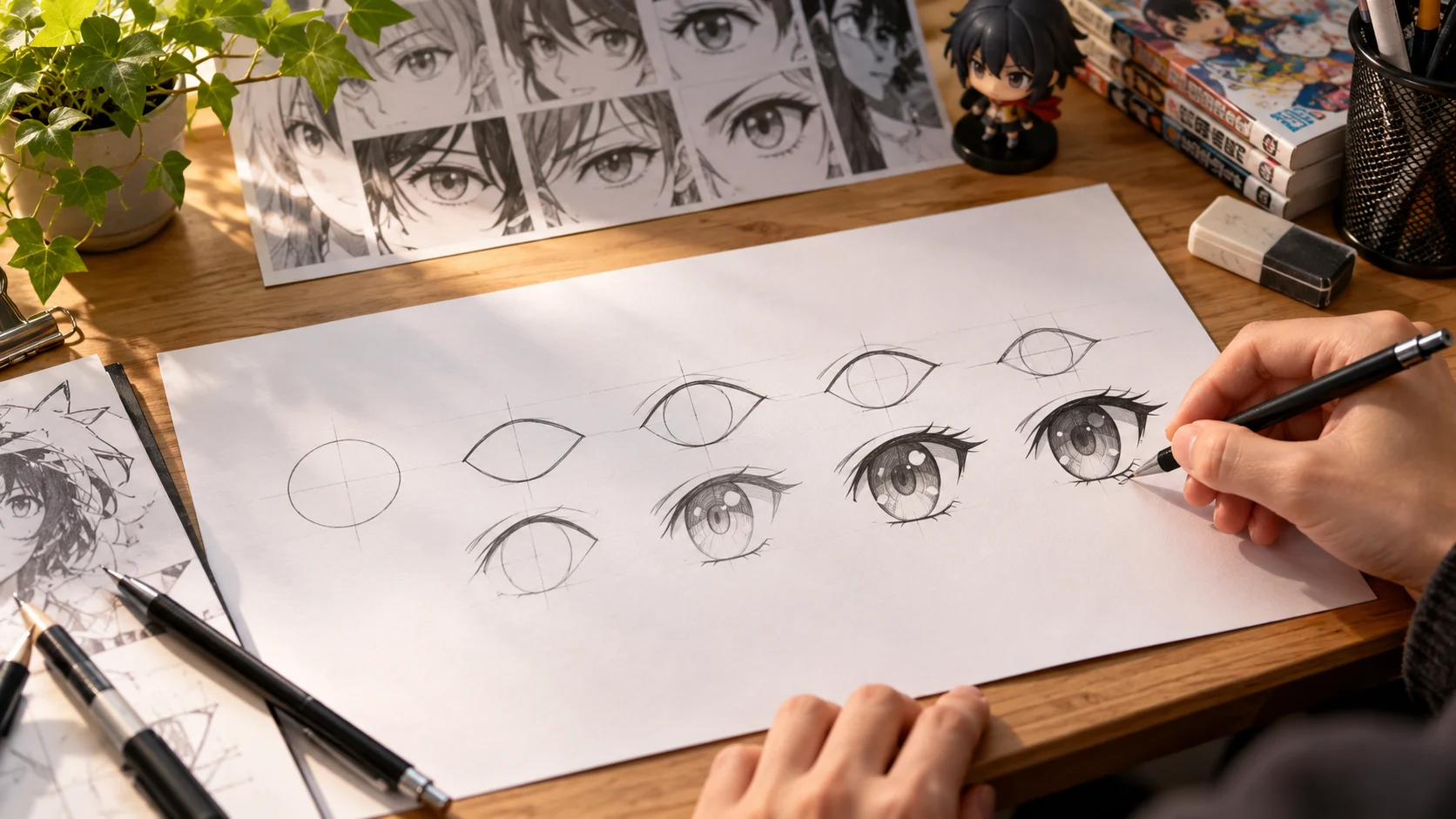
A manga eye is built in layers. Each shape hides another, so the order matters.
- The upper eyelid: a thick arch, the most important shape, which gives the expression.
- The lower eyelid: a fine line, sometimes absent, which closes the shape.
- The iris: a tall oval, cut off by the upper eyelid, never whole.
- The pupil: a darker oval at the center of the iris.
- The highlight: one or two light spots that bring it to life.
If you remember only one thing, remember the upper eyelid. Thick and dark, it frames the gaze. A soft eyelid makes a soft eye, no matter how much care is put into the iris.
Iris and Reflection: Bringing the Gaze to Life
The iris is never a complete circle. The upper eyelid partially covers it, which avoids a permanently surprised look. Only strong emotion (fear, shock) reveals the white above the iris.
The highlight is placed on the side of the light source, and it must be the same in both eyes. Two highlights that don't look at the same lamp make a character look cross-eyed without the gaze having moved.
A gradient in the iris, darker at the top and lighter at the bottom, is enough to give it volume. No need for extra details for a clean first result.
Eyelashes, eyebrows and emotion
Eyelashes are drawn in groups of two or three strokes, not one by one. They extend the upper eyelid outward and weigh down the gaze.
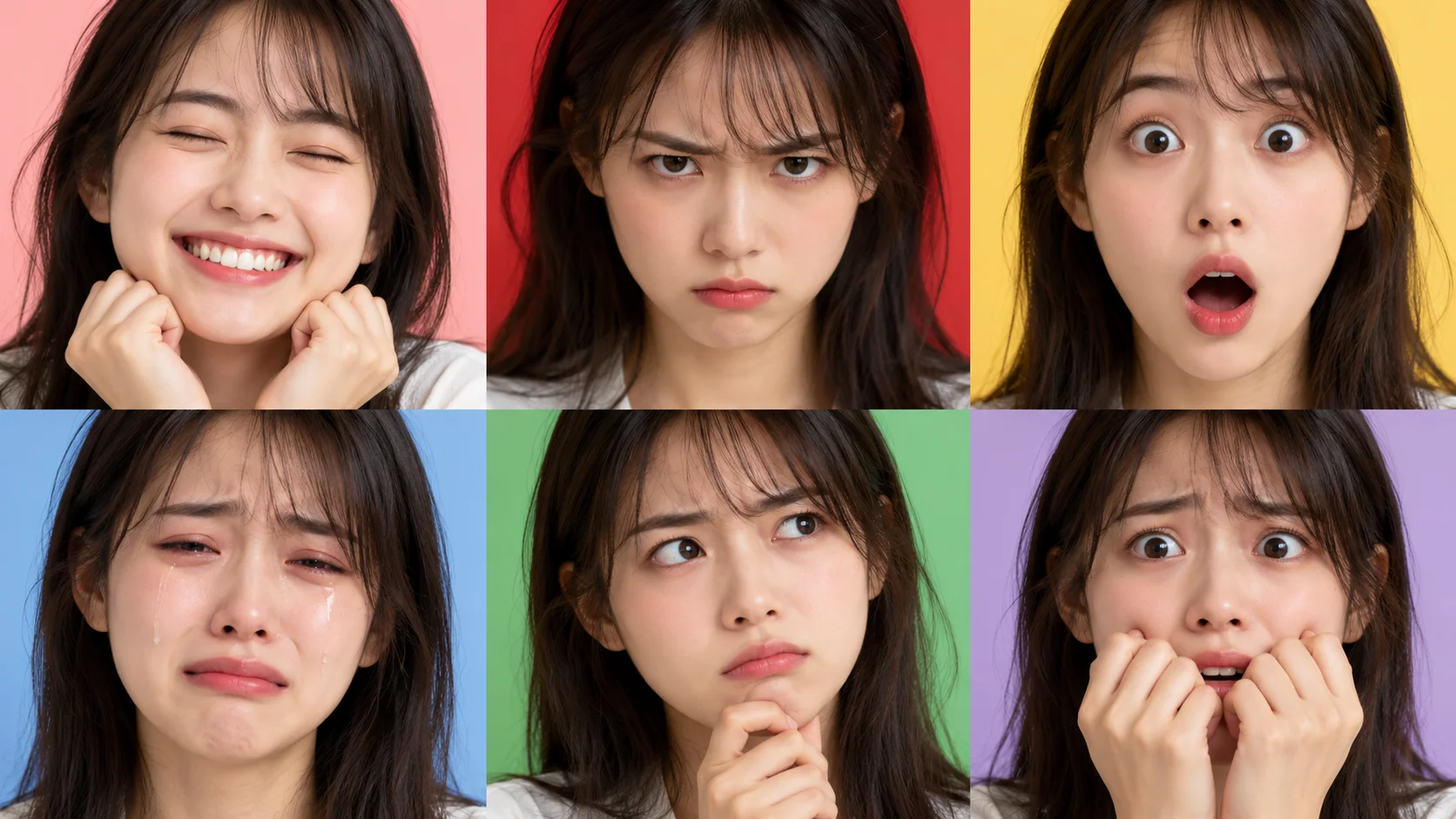
The eyebrow carries emotion just as much as the eye. Placed low and tilted toward the nose, it conveys anger. High and curved, surprise. The same eyes, with three different eyebrows, make three characters.
The complete face follows the same principles. For the construction of an entire character, see comment dessiner un personnage de manga, where the standard adult is seven to eight heads tall, which determines the relative size of the eyes.
The mistakes that make a gaze look blank
Four mistakes keep coming up: eyes of different sizes, an iris that is too large and extends beyond the eyelid, a missing highlight, and an eye line that tilts with the head when it should follow the perspective of the face.
To fix this quickly, flip the drawing or look at it in a mirror. Differences in size and tilt immediately jump out at you.
If you want to produce complete pages without spending hours on every gaze, Bulle.ai generates characters with a stable face from one panel to the next, allowing you to focus on the story.
Conclusion
To draw manga eyes, position the eye line, place the upper eyelid first, cut the iris with it, then add the reflection and lashes. Repeat the sequence ten times on the same construction before changing styles.
Once your eyes are consistent from one drawing to the next, you can move on to the body, hands, and full comic page. And if your goal is to publish a story rather than perfect a single gaze, try Bulle.ai.