Positioning the mouth before drawing it
A well-drawn mouth in the wrong place is still a wrong mouth. As with the eyes, everything relies on reference points drawn with a light pencil.
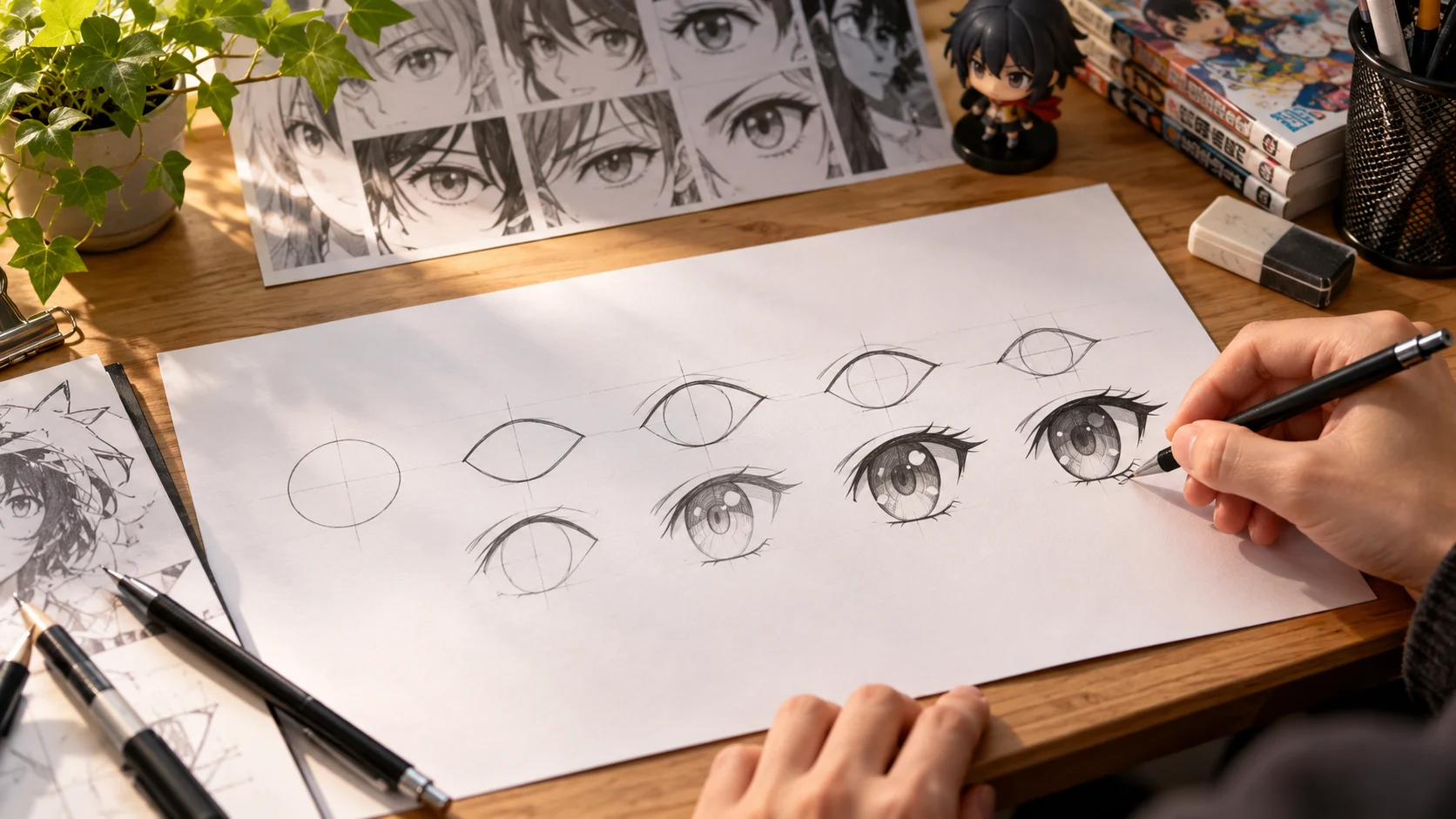
Start from the eye line, positioned in the middle of the head (a little lower in manga, which enlarges the forehead). The detail is explained in the article on how to draw manga eyes. Between this line and the chin, the mouth is placed in the lower third, closer to the chin than to the nose.
The lower the mouth, the younger the face appears. This is a character setting: a childish character has a mouth very close to the chin, while an adult character moves it up a bit.
- Vertical axis: the mouth is centered under the nose, on the axis of the face.
- Width: it does not exceed the width of one eye in a stylized front-facing view.
- Three-quarters view: the axis curves, the mouth follows, and the far side shortens.
The four basic shapes
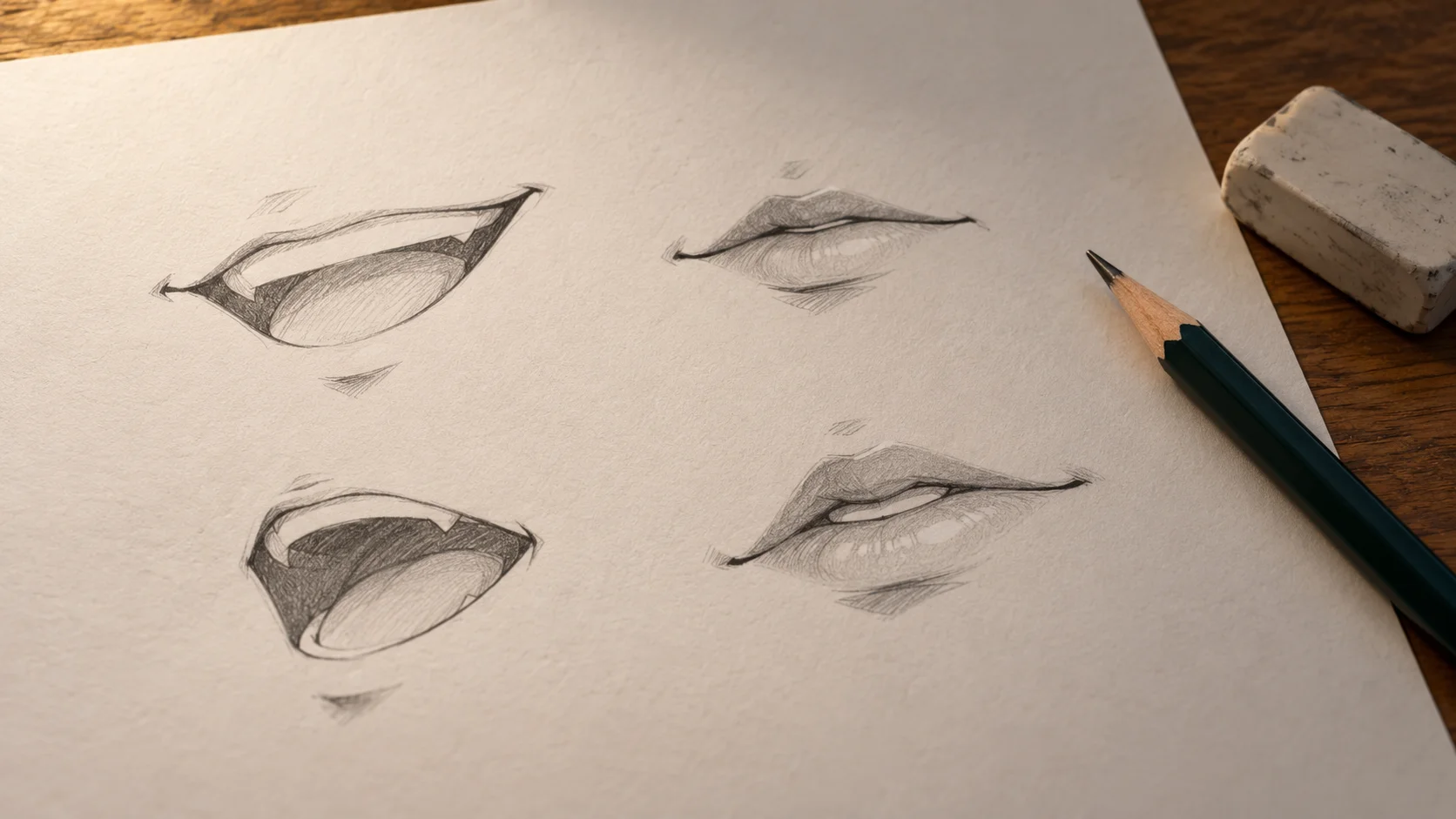
Almost all manga mouths derive from four shapes. Master them, and you cover the majority of panels.
- The neutral mouth: a short stroke, slightly thicker in the center. No lips drawn.
- The smile: a gentle arc, sometimes with a small dimple at each end. The deeper the arc, the wider the smile.
- The open mouth: a half-oval whose top is a straight line or a slight arc. Add the tongue at the bottom, a single flat fill.
- The sad or angry mouth: a downward-curving stroke, or a trembly stroke for anger.
In all cases, a single main line carries the emotion. The rest is just accompaniment.
Teeth, tongue, and lips: how much to show
Manga simplifies. Lips are almost always suggested by a thick line in the center, rarely drawn as two shapes. Teeth, when they appear, are a white band without individual separation, except for the canines of a mischievous character.
The tongue is limited to a darker flat tone at the bottom of the open mouth. If you are starting out, add one detail at a time: too many lines in such a small space make the mouth unreadable once reduced to the size of a panel.
The mouth follows the eyes and eyebrows
An expression is never read from the mouth alone. A smile with drooping eyebrows conveys awkwardness; the same smile with tilted eyebrows conveys mischief.
When drawing a series of faces, change all three elements together: eyes, eyebrows, mouth. To keep the same character from one page to the next, keep the same mouth width and placement, just as you keep the eyes identical in la cohérence des yeux.
Errors that distort the face
- A mouth that is too large, which overwhelms the eyes and ages the character.
- A mouth off-center relative to the nose, especially in three-quarter view.
- Too many lines: lips, shadows, teeth, and tongue all together.
- The exact same mouth for every emotion, resulting in a stiff face.
- A mouth placed too high, which shortens the chin.
To check, flip the drawing in a mirror or upside down: a placement error immediately jumps out at you.
Conclusion
First, position the mouth on the axis of the face, in the lower third. Then choose one of the four shapes and limit yourself to a single stroke that carries emotion. The rest is practice: a page of mouths a day for a week is better than one perfect drawing. To go from a face to a full comic page, you can also test Bulle.ai, which generates panels from your script, and the Bulle.ai page shows examples of public projects.