
Why read a manga like an artist
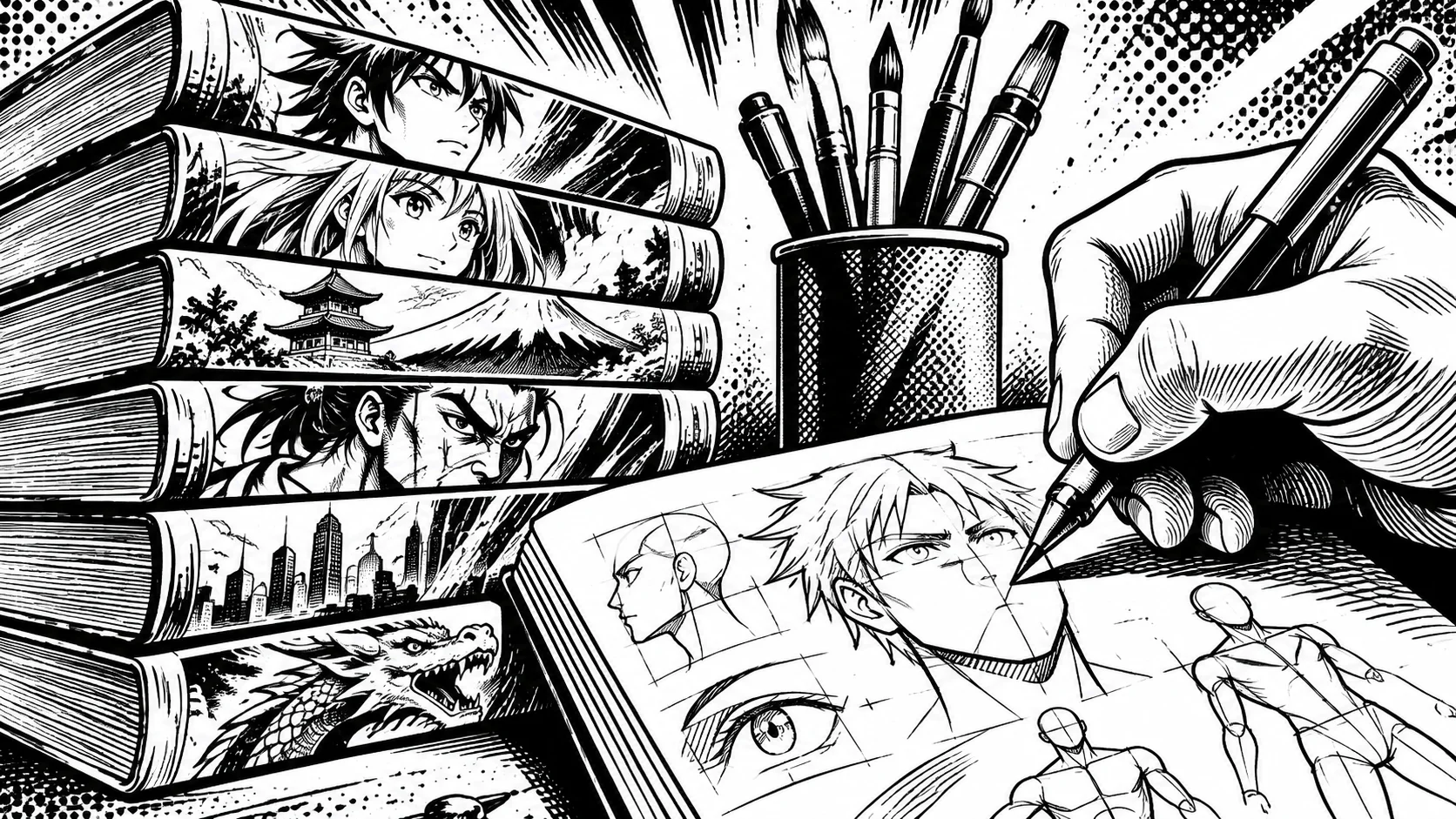
Reading for the story and reading to learn are two different acts. In the second, you reread the same page three times: once for the narrative, once for the composition, once for the line work.
Take a pencil and a notebook. Look for a single thing per page: where the eye enters, how the panel guides the reading, how the ink separates the planes. One studied page is worth more than ten skimmed pages.
Dragon Ball: clean lines and readability
Akira Toriyama's drawing relies on simple shapes and a clean line. The silhouettes can be read at a glance, even in the middle of action.
- What we learn here: how to simplify a character without making them look poor.
- Exercise: redraw a character using only circles, cylinders, and cubes, then add the details.
To start off on the right foot, also check out truly easy subjects, ranked by difficulty.
One Piece: movement and expressiveness
Eiichiro Oda pushes deformations: huge mouths, stretched bodies, exaggerated poses. The result remains readable because the energy of the gesture takes precedence over anatomical accuracy.
- What we learn: exaggerate a pose so that it carries emotion.
- Exercise: draw the same pose twice, one realistic, one pushed to the maximum, and compare.
Vagabond: inking and realism
Takehiko Inoue works with a stroke close to ink painting, with realistic anatomies and powerful blacks. It is a school of patience.
- What we learn: vary line thickness to give volume.
- Exercise: ink a face with a thin line for distant outlines and a thick line for cast shadows.
Death Note: detail and staging
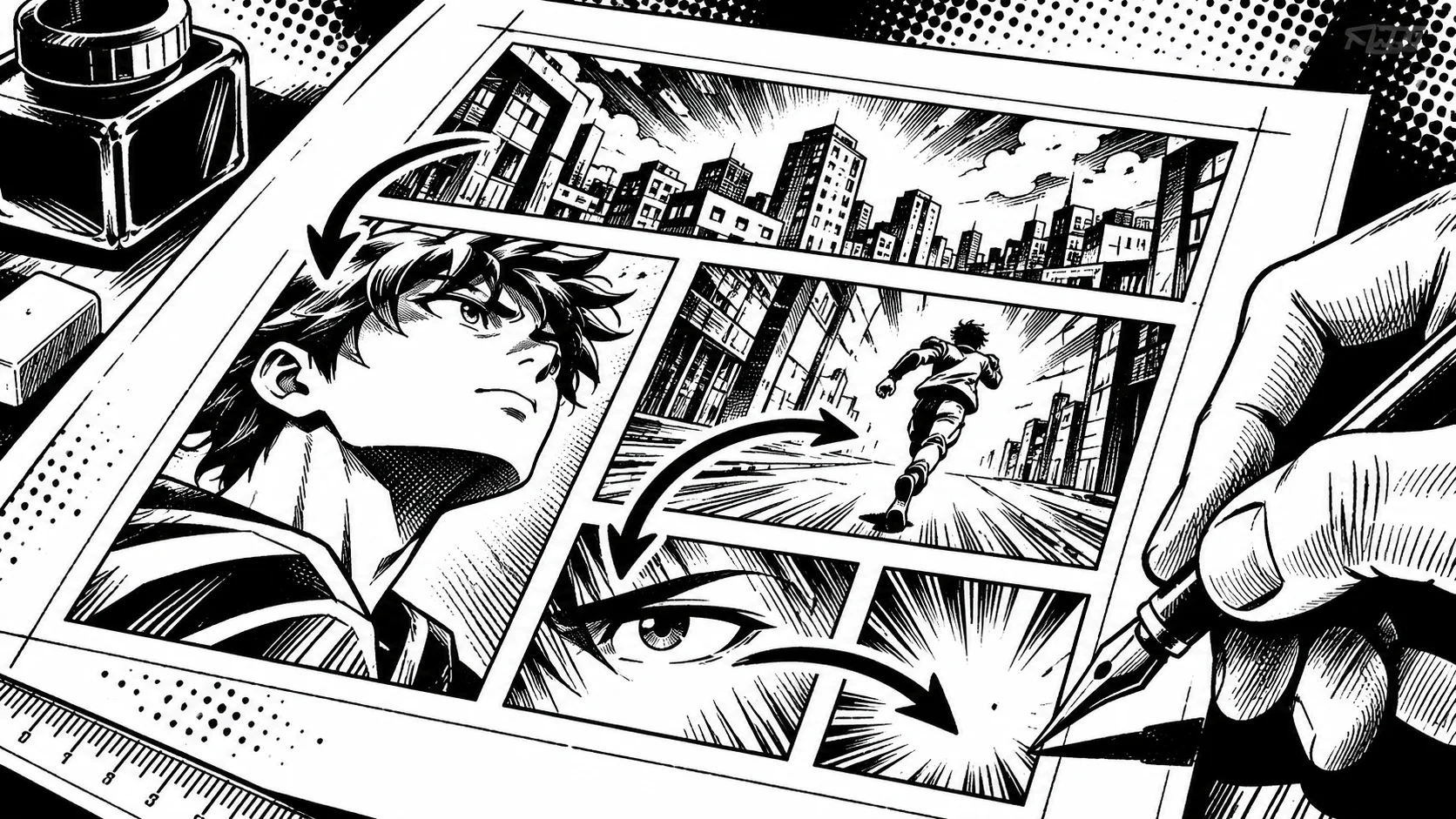
Takeshi Obata draws fine faces and highly detailed clothing. Panels tight on the gaze or the hand create tension without any movement.
- What we learn: make stillness a scene.
- Exercise: choose a dialogue scene and draw it in six panels where no one moves, only the framing changes.
Slam Dunk: anatomy in action
Basketball allows us to see bodies jumping, supporting, twisting. Proportions remain consistent from one panel to the next, making it a reference for posture.
- What we learn: capture movement and balance in sports action.
- Exercise: draw a jump shot breaking down the trajectory into three key moments.
To go further on this point, read our article on posture.
Berserk: screentone, hatching and atmosphere
Kentaro Miura fills his pages with fine hatching and textures. We study how a surface is built stroke by stroke.
- What we learn: give texture without resorting to mechanical screentone.
- Exercise: shade a sphere using only cross-hatching.
If you prefer screentones, here is how to choose density and avoid moiré.
How to choose yours
Take the series whose artwork makes you want to draw, not the most famous one. If you hesitate, start with clean linework, then add inking, then movement.
- The clean line school (like Dragon Ball): to master proportions and readability.
- The ink school (like Vagabond): to master contrast, weight, and gesture.
- The texture school (like Berserk): to master depth and atmosphere.
Study ten pages, not ten volumes. And keep a notebook of what you understood: three lines per page are enough.
When you want to move from study to your own story, a tool like Bulle allows you to produce pages without knowing how to draw: the Beginner pack is €19.90 for 2,000 credits, and a manga project consumes 500, which is 4 projects. It is a way to test a script before drawing it by hand.
Conclusion
The best manga to progress are not necessarily those in the rankings. Choose a series, a technique, an exercise, and start again the following week with another. To compare styles, also read shonen, shojo, seinen: finding your own.