Choosing the light source above all
A shadow is always the reverse side of a light. Before darkening anything, decide where it comes from: top left, top right, front, side, or backlighting. Note it in blue pencil in a corner of the panel.
Next, a single rule: all shadows in the panel go to the side opposite the source. If the light comes from the top left, the chin, the underside of the hair, and the right side of the nose are in shadow. A shadow that changes sides from one element to another immediately betrays an amateur.
Keep the source simple. One main light is enough for a panel. Double lighting can be worked on later, once the first one is automatic.
The 3 shadows to know
Core shadow
This is the shadow found on the object itself, on the side opposite to the light. On a face: under the nose, under the lower lip, under the chin, under the bangs. On an arm: the underside. It follows the shape: it curves on a cylinder, it is flat on a plane.
Cast shadow
This is the shadow that the object casts on its surroundings: the ground, a wall, another character. It grounds the drawing. A character without a cast shadow floats, even if well drawn. Its direction follows the light, its length depends on the height of the source: low light, long shadow; high light, short shadow close to the feet.
Form shadow
This is the contact shadow between two touching volumes: the neck under the jaw, the bend of the elbow, the junction between the hand and the sleeve. It is small, dark, and it is what gives the impression that the pieces fit together instead of being glued on.
- Core shadow: gives volume.
- Cast shadow: gives placement in space.
- Form shadow: gives the logic of junctions.
Where to place them on a face and a body
On a front-lit face viewed straight on, core shadows fall in the exact same place every time: under the bangs on the forehead, under the upper eyelashes, under the nose, under the lower lip, under the chin, and on the neck. Small areas are enough: in a manga style, the skin remains light and restraint is what ensures readability.
On the body, look for hollows and undersides: under the chest, under the raised arm, behind the bent knee, under hanging fabric. Clothing folds create form shadows inside each deep fold; to place them, also see our guide on manga clothing.
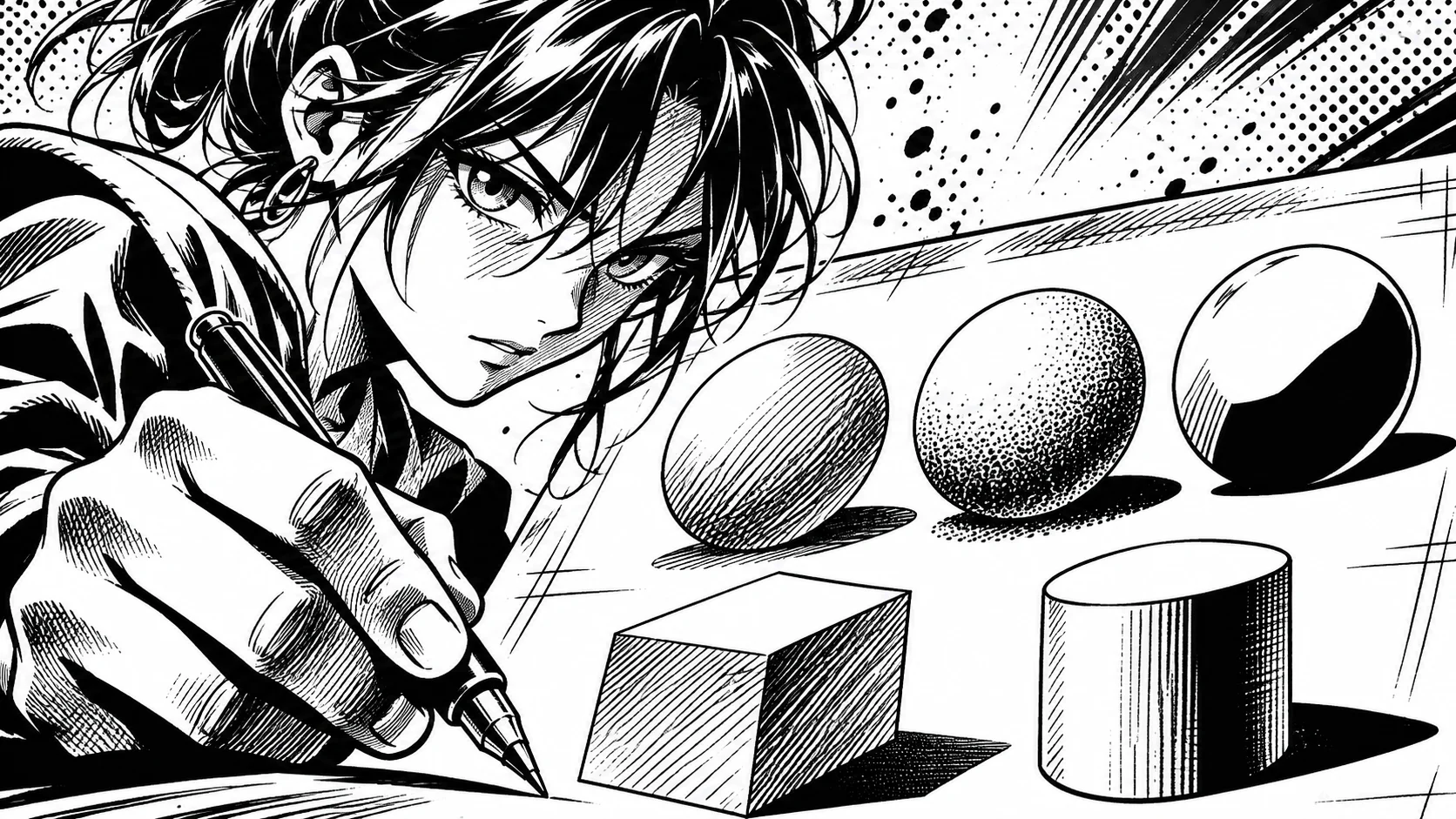
The classic trap is to shade everything the same way. Keep three levels: direct light (white), halftone (screentone or hatching), and direct shadow (black). The three together give more depth than ten grays.
How to render them in black and white
Hatching
Parallel lines, tight for dense shadow, spaced out for halftone. They are drawn in the direction of the form: curved on a round volume. This is the fastest method and requires no extra equipment.
Solid black
For a hard shadow: backlight, night, strong emotion. A well-placed large solid black area has more impact than a gradient. Keep it for the places that matter, otherwise the page becomes heavy.
Screentone
This is the classic solution for halftone. In our guide on manga screentone, 60 L at 10 to 20% is used for skin shadows and light clothing, and 60 L at 30 to 40% for dark hair and deep shadows. Both overlap cleanly, with a 30-degree difference to avoid moiré.
What if you don't know how to draw shadows
If you want to see right away how a scene breaks down into shadows and highlights, you can generate pages on Bulle, which offers over 20 art styles as well as the definition of backgrounds and moods. It's a way to spot how lighting structures a panel before reproducing it by hand.
Conclusion
A manga shadow is decided before it is drawn: one light source, then three shadows—core, cast, and form—each answering a different question. Place them in the hollows and undersides, keep three levels (white, halftone, black), and choose the rendering according to the desired effect: hatching to go fast, solid fill for drama, screentone for clean halftone. Next, move on to color manga drawing, where the same rules of light apply to values.