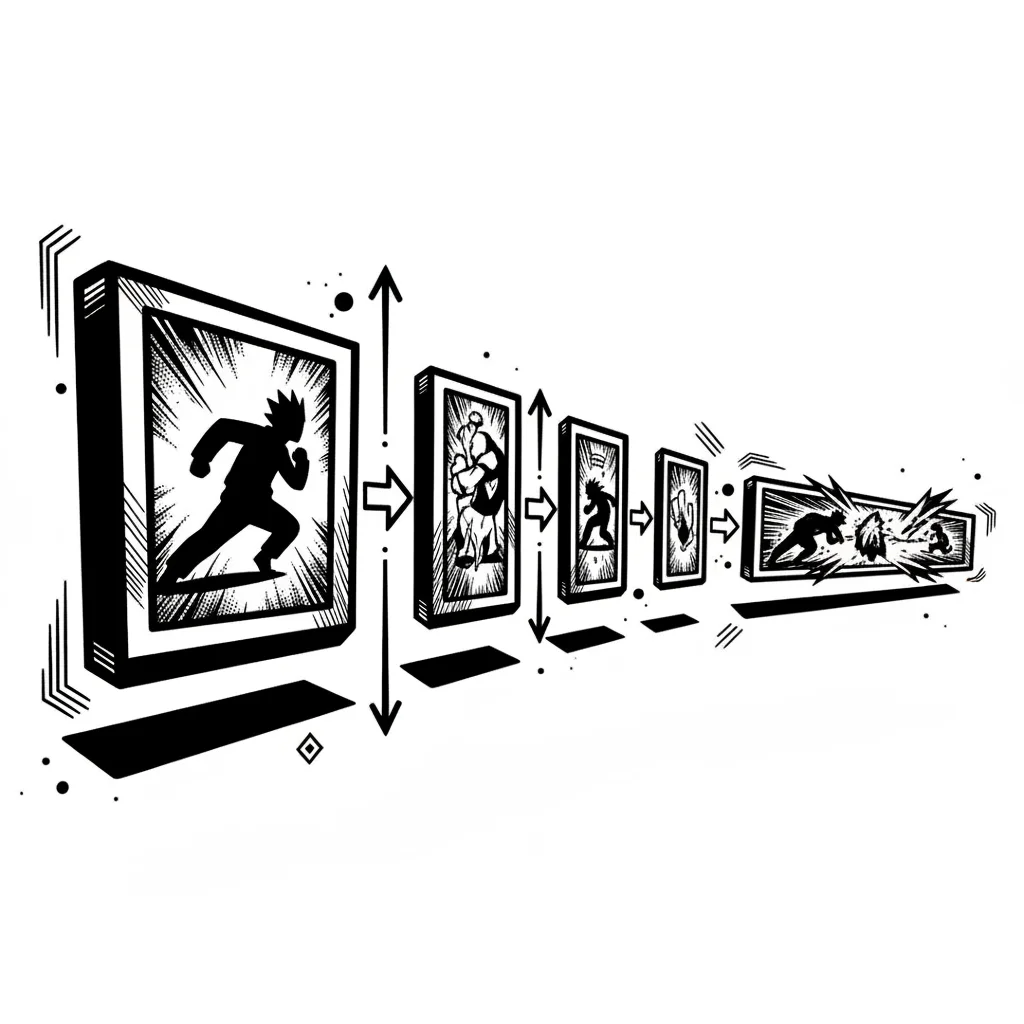

The Era of the Classic Panel: Foundations and Conventions
The Basics of Traditional Manga Layout
Page structure and reading flow are paramount in classic manga. The panel, the fundamental narrative unit, has its size, shape, and arrangement determined by the need to guide the reader's eye. Whitespace and margins play a crucial role in visual rhythm and the progression of action, creating pauses or accelerations.
The Influence of Printing Constraints
The paper format heavily influenced the layout. The management of details and visual density had to be considered for clear reading on a printed page. Graphic consistency over the duration of a printed series was also a determining factor in creating your manga professionally.
The Emergence of Digital Formats: First Steps
Adapting pages for screen reading presented the first challenges. Screen miniaturization and resolution necessitated rethinking the readability of details and the clarity of panels, foreshadowing future developments.
- Optimized page structure and reading flow
- The panel as a narrative unit: size, shape, and arrangement
- The role of whitespace and margins in rhythm
- Impact of paper format on composition
- Management of details and visual density
- Graphic consistency for creating lasting manga
- Adapting pages for digital reading
- The challenges of miniaturization and resolution
Ready to Create Your Manga
Discover how to structure your story and optimize your layout for all formats.
Explore ToolsFrom Webtoon to Scrolling: New Formats, New Rules
What distinguishes the webtoon format from the classic comic page?
The webtoon format revolutionizes conventions with its infinite vertical scroll. This approach completely rethinks visual storytelling, favoring a continuous and immersive flow that transforms the reading experience.
How does the webtoon format influence narrative pacing?
The pace is dictated by the scrolling speed and how the panels connect vertically. The mangaka must adapt their paneling to maintain the reader's attention over time and create their manga with this new logic.
What techniques maintain reader engagement in a vertical format?
The use of fluid transitions, progressive reveals, and careful composition of each panel is essential to capture and hold interest. The management of visual cliffhangers becomes crucial.
Does infinite scrolling present specific challenges?
The advantage lies in creative freedom and total immersion. The disadvantage can be managing reader visual fatigue and the need for rigorous planning to avoid narrative longueurs.
How to optimize readability in a webtoon format?
The size and positioning of speech bubbles are crucial. They must be easily readable without interrupting the visual flow, while integrating harmoniously with the artwork for a smooth experience.
Mastering Webtoon Layout
Learn specific techniques to captivate your readers on digital platforms.
Webtoon TipsArtificial Intelligence in Service of Layout Evolution
Artificial intelligence offers avenues to quickly explore different paneling variations, allowing for testing the impact of the same scene on the reader's pacing and perception. This is a major asset for those who wish to create their manga with a methodical approach.
Adapting paneling from a classic page to a webtoon format can introduce inconsistencies. AI can help identify and correct these discrepancies to maintain a strong visual identity.
Platforms are constantly evolving, and with them, reader expectations. Artificial intelligence can analyze trends to suggest paneling adaptations that resonate with the most popular formats, thus facilitating the creation of a manga tailored to the target audience.
For authors juggling multiple projects, AI can unlock key stages, such as generating paneling ideas or establishing a coherent visual structure, freeing up time for pure creation.
Artificial intelligence is becoming a valuable partner for independent creators, facilitating iteration and consistency, essential elements for producing professional-quality manga.
AI for Your Creativity
Use artificial intelligence to speed up your creation process and ensure the consistency of your series.
Discover AI ToolsConclusion
The evolution of manga layout, from classic panels to web formats, testifies to the remarkable adaptability of this medium. Each new format brings its share of challenges and opportunities, pushing the boundaries of visual storytelling. The thoughtful integration of artificial intelligence tools can significantly help creators navigate these changes, optimize their workflow, and produce impactful works for all media. Embracing these evolutions means ensuring you reach an ever-wider audience and remain relevant in a constantly changing editorial landscape, while concretely facilitating the process of creating your manga.