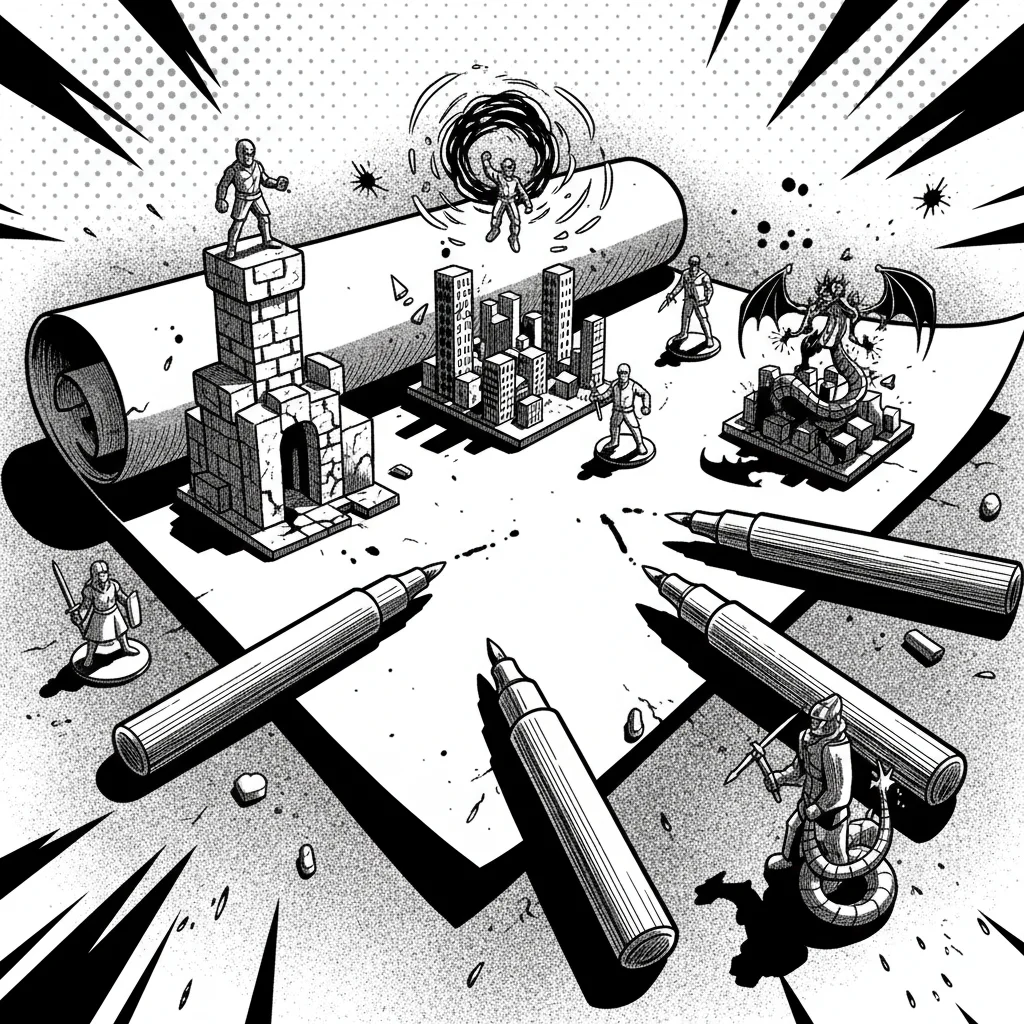

The Visual Impact of Backgrounds on Reader Perception
Setting as a Mirror of Emotion
The setting is not just a simple backdrop; it actively participates in the atmosphere and emotion you wish to convey. A dark and oppressive environment can emphasize a character's distress, while a vast and bright landscape can evoke freedom or hope. The way you depict these elements directly influences how the reader will feel the scene.
Perspective, whether classic, high-angle, or low-angle, is not just a matter of technique. It serves to guide the reader's gaze, to accentuate a character's power or, conversely, their vulnerability. Poor management of perspective, or its absence, can make a scene confusing and unengaging.
Setting elements, even subtle ones, contribute to the credibility and richness of your universe. An ordinary object can tell a story, contextualize an action, or reveal a character trait. Ignoring these details means impoverishing the world you create and, by extension, the reader's experience.
Improve Your Backgrounds
Learn to master perspective and details to create captivating worlds.
Discover TechniquesCommon Mistakes That Harm Immersion
Visual Overload and Lack of Focus
A tendency to want to fill every space can paradoxically harm clarity. When too many elements draw attention simultaneously, the reader no longer knows where to look. This creates a sense of clutter and makes it difficult to understand the main action. It is essential to know how to prioritize background elements to highlight the subject of the panel.
It is crucial to distinguish what is essential from what is superfluous so as not to drown out the message of the page. A balanced composition allows the reader to focus on the essentials and improves the approach to creating a readable manga.
Spatial and Temporal Inconsistency
Continuity errors in backgrounds, such as objects changing places without reason or architectures that defy logic, immediately break immersion. The reader, even unconsciously, perceives these inconsistencies as mistakes that pull them out of the story. Environmental consistency is as important as character consistency.
Ensure that your universe respects its own rules to maintain the credibility of your narrative and create a coherent manga from beginning to end.
Avoid Common Mistakes
Don't let your backgrounds harm immersion. Identify and correct inconsistencies.
Tips for ClarityTurning Your Backgrounds into Narrative Assets
For your settings to truly serve your story and captivate your readers, a thoughtful approach is necessary. Here are the key steps to transform your backgrounds into powerful narrative elements and improve how you create manga.
- Define the setting's function: Each element must have a reason for being, whether atmospheric, narrative, or symbolic.
- Study perspective: Master the rules of perspective to guide the viewer's eye and enhance the visual impact of scenes.
- Simplify to better focus: Know which elements are essential and which can be softened to avoid cluttering the composition.
- Ensure visual consistency: Maintain logical continuity in space and time so that the universe remains believable.
- Use the setting to reveal character: Integrate details into the environment that say a lot about the characters who inhabit it.
- Play with light and shadow: Employ these tools to shape space, create atmosphere, and direct attention.
- Incorporate symbolic elements: Use recurring objects or motifs to enrich the meaning of your story.
- Consider dialogue readability: Ensure that the setting does not interfere with the placement of speech bubbles and onomatopoeia.
Structure Your Project
Use tools to visualize your ideas and organize the creation of your panels.
Try Bulle.aiConclusion
Immersion in a manga relies on a multitude of factors, and backgrounds play a fundamental role. By paying close attention to their design, consistency, and narrative function, you significantly enrich your readers' experience. Remember that every detail counts to bring your universe to life and create a memorable manga.