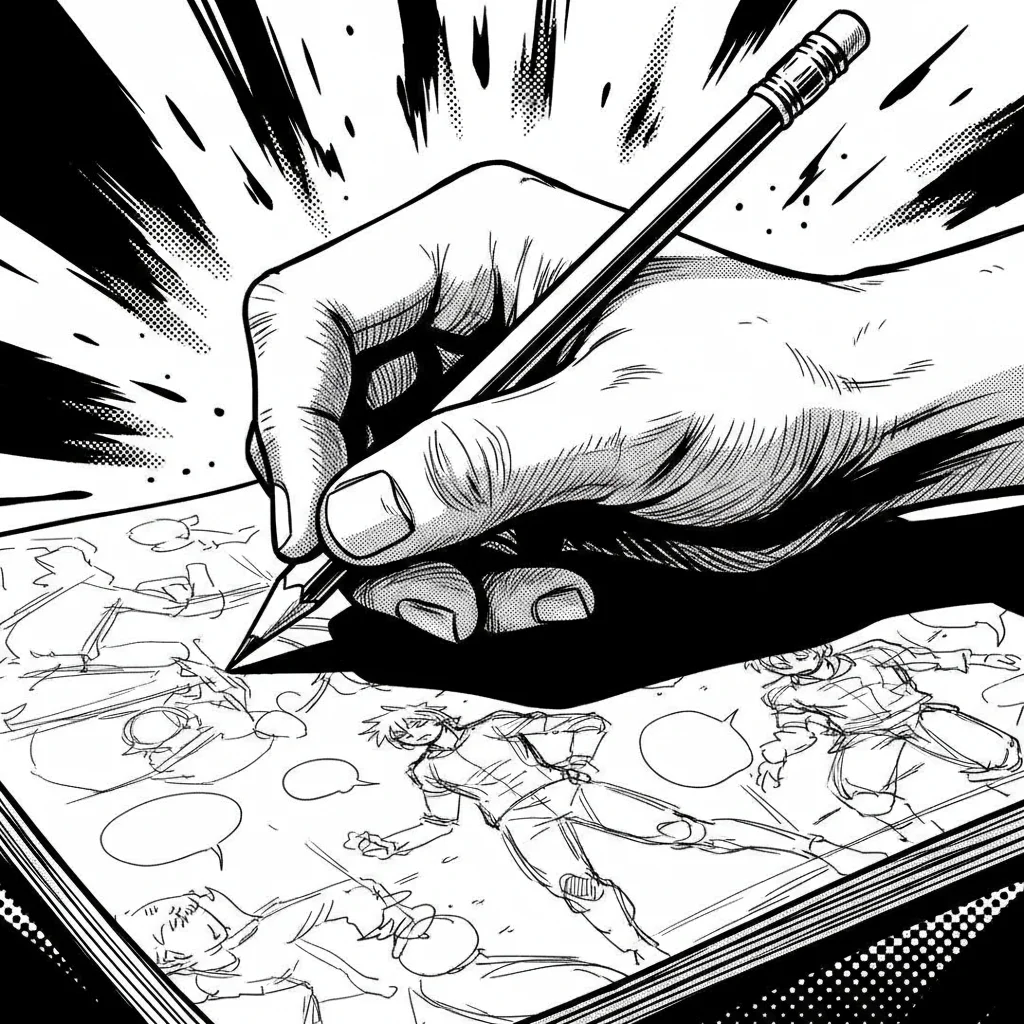

The Foundations of Your Narrative Arc
Define the core of your story
What is the main theme of your manga? What message do you want to convey? Identifying the central conflict that will drive your narrative is the first step in creating your manga with a solid narrative foundation.
The protagonist's journey
Understanding your main character's deep motivations, determining their goals and weaknesses, and anticipating their transformation throughout the story is crucial for structuring a coherent narrative arc.
The pillars of narrative structure
The introduction of characters and setting, the inciting incident that kicks off the action, as well as points of tension and plot twists form the basis of good storytelling. These elements constitute the skeleton on which you will build your manga.
Ready to Structure Your Manga
Transform your ideas into a captivating story with a solid narrative structure. Discover how to organize your story to keep your readers on the edge of their seats.
Discover the StepsKey Steps for Captivating Progression
Step 1 — Exposition and Setup
Introduce your world and main characters. Lay the groundwork for your plot and pique the reader's curiosity from the very first pages.
This phase establishes the overall tone of your narrative and presents the essential elements the reader needs to know to follow the story.
Step 2 — Conflict Development
Gradually increase the tension. Your characters face growing obstacles, their relationships evolve, and the stakes become clearer.
This is where you develop subplots and delve deeper into your characters' psychology.
Step 3 — Climax
The moment of truth in your narrative arc. This is the peak of the conflict, where characters must face their greatest challenges and make crucial decisions.
This stage concentrates all the accumulated tension and constitutes the major turning point of your story.
Step 4 — Resolution and Aftermath
The fallout from the climax. How do the characters handle the consequences of their actions? What is the new balance established?
This phase allows for the untangling of plot threads and shows the characters' evolution.
Step 5 — Optional Epilogue
A glimpse into the future, showing the long-term impact of events on the characters and their world.
This conclusion can open up new arcs or offer a satisfying closure to your narrative.
Bring Your Characters to Life
Learn to build complex and relatable characters whose journey will shape your narrative arc. The development of your protagonists is essential.
Deepen Character DevelopmentRefining Your Narrative Arc with Modern Tools
The pacing of your story determines reader engagement. How does panel breakdown influence the perception of time and action? Good reading rhythm is essential to maintain attention and know when to speed up the action or let the reader breathe.
Ensure the graphic style supports the mood of your story and that themes are explored consistently across narrative arcs.
Artificial intelligence can help generate ideas, explore variations of narrative arcs, or check the consistency of your script. These modern tools allow for rapid iteration on your concepts while keeping the creative eye at the center of the process for creating your manga.
Don't be afraid to revisit your plan, modify it, and improve it. Revision is a key step in the creative process to finalize and perfect your manga.
The visual planning of your narrative arc helps you identify strong moments and necessary transitions between the different phases of your story. This methodical approach facilitates the creation of a fluid and captivating narrative progression.
Accelerate Your Creation with AI
Explore how artificial intelligence tools can assist you in structuring your script and generating ideas for your manga.
Explore AI ToolsConclusion
Structuring your manga's narrative arc is a fundamental step in creating your manga professionally and captivatingly. By clearly defining your foundations, following the key progression steps, and using the tools at your disposal, you maximize your chances of captivating your readers. Remember that the key lies in coherence, pacing, and character transformation. Get started and bring your story to life! Use these concrete benchmarks to move from the desire to the realization of your manga project with a structured and effective approach.