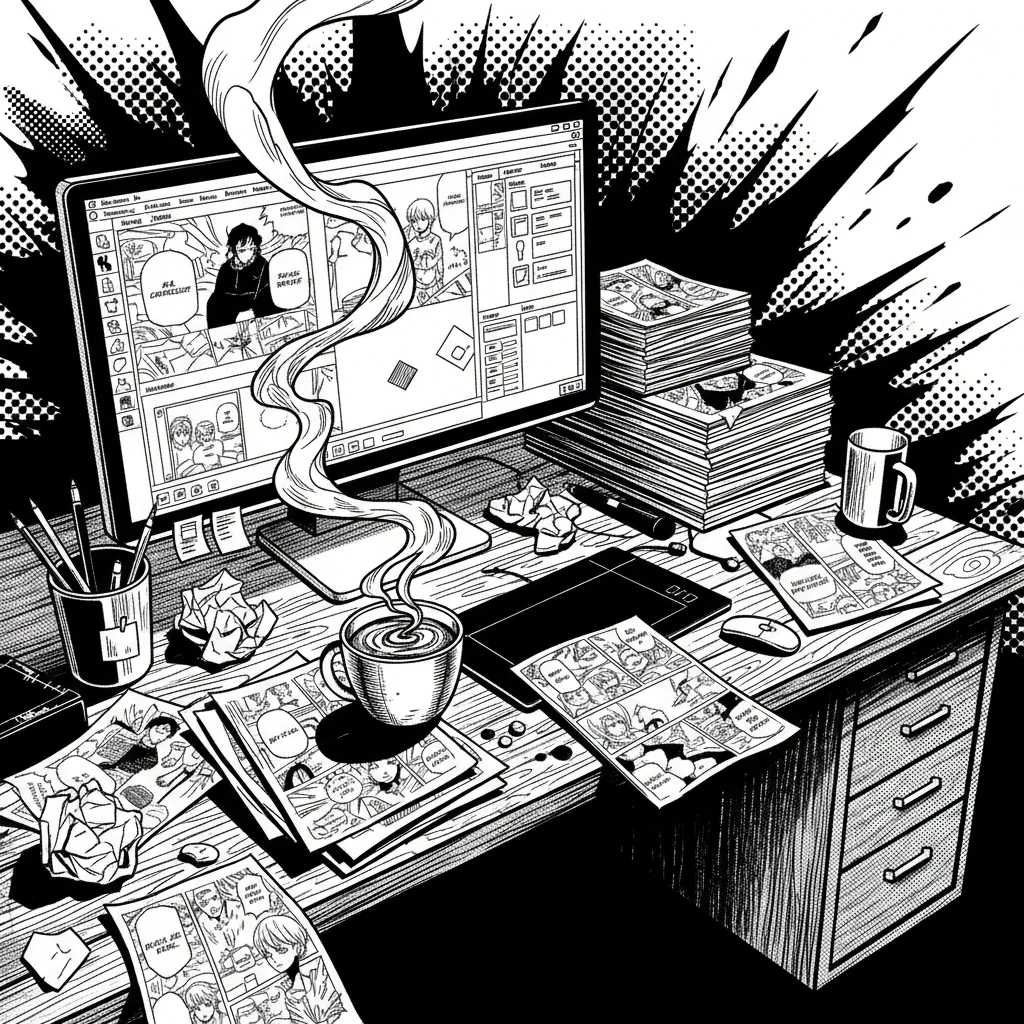

Identifying Problematic Scene Transitions
What is a scene transition in manga?
A scene transition marks the passage from one moment, place, or action to another within your story. It can be as simple as a change of panel or as complex as a time jump.
Signs of a rhythm-breaking transition
An ineffective transition manifests as a break in comprehension or immersion. The reader may feel lost, disconnected from the story, or fail to understand the logical or emotional link between two sequences. This can be due to a lack of visual cues, an abrupt change in mood, or a poorly managed ellipsis.
The impact on reader immersion
When transitions are clumsy, the reading experience is degraded. The reader loses the thread, their engagement diminishes, and the emotion you sought to convey can be diluted, or even lost. A good transition keeps the reader within the universe of your manga.
The importance of visual and narrative consistency
Ensuring consistency between scenes is crucial. This involves maintaining a similar graphic style, an appropriate tone, and a narrative logic that guides the reader effortlessly. A successful transition strengthens the overall structure of your work and the impact of each page.
Structure Your Scenes Methodically
Learn to clearly define the beginning and end of each sequence for better narrative continuity.
Discover the StepsKey Steps for Smooth Transitions
Mastering the art of scene transition requires a methodical approach. Here are the fundamental steps to ensure seamless narrative continuity in your manga.
- Clearly define the starting and ending point of each scene to create your manga with consistency.
- Anticipate the logical or emotional connection between two narrative sequences.
- Use recurring visual elements to harmoniously link scenes.
- Adapt the panel layout to naturally guide the reader's eye.
- Play with temporal and spatial ellipses intentionally and skillfully.
- Introduce characters or objects as narrative bridges between key moments.
- Verify the consistency of tone and atmosphere from one scene to another.
- Test the flow by having others read the pages to validate the experience.
Optimize Your Creative Process
Explore modern tools to improve the efficiency of your transitions and speed up your creation.
Explore SolutionsTools and Techniques to Optimize Your Transitions
Optimize Your Scene Transitions
To go further and perfect your scene transitions, several approaches and tools can help you gain efficiency and quality. Let's compare different methods to choose the one that best suits your manga creation project.
| Technique / Tool | Description | Advantages | Disadvantages |
|---|---|---|---|
| Traditional manual breakdown | Planning on paper or classic drawing software. | Total control, maximum creative flexibility. | Can be time-consuming, less automation available. |
| Assisted storyboard software | Digital tools offering preview and organization features. | Quick visualization, efficient version management. | Learning curve required, potential acquisition cost. |
| AI assistance for visual consistency | Using AI tools to generate variations or ensure stylistic continuity. | Accelerated iterations, valuable help in idea generation. | Requires constant critical review, risk of losing originality if misused. |
Launch Your Manga Series Project
Discover how Bulle.ai can assist you in structuring and visualizing your series.
Learn More About Bulle.aiConclusion
Scene transitions are a discreet but fundamental pillar of manga storytelling. By paying close attention to their fluidity, you significantly improve the reading experience and strengthen the impact of your work. Don't hesitate to explore new methods and rely on modern tools to refine your art and transform your ideas into captivating pages when you decide to create your manga.