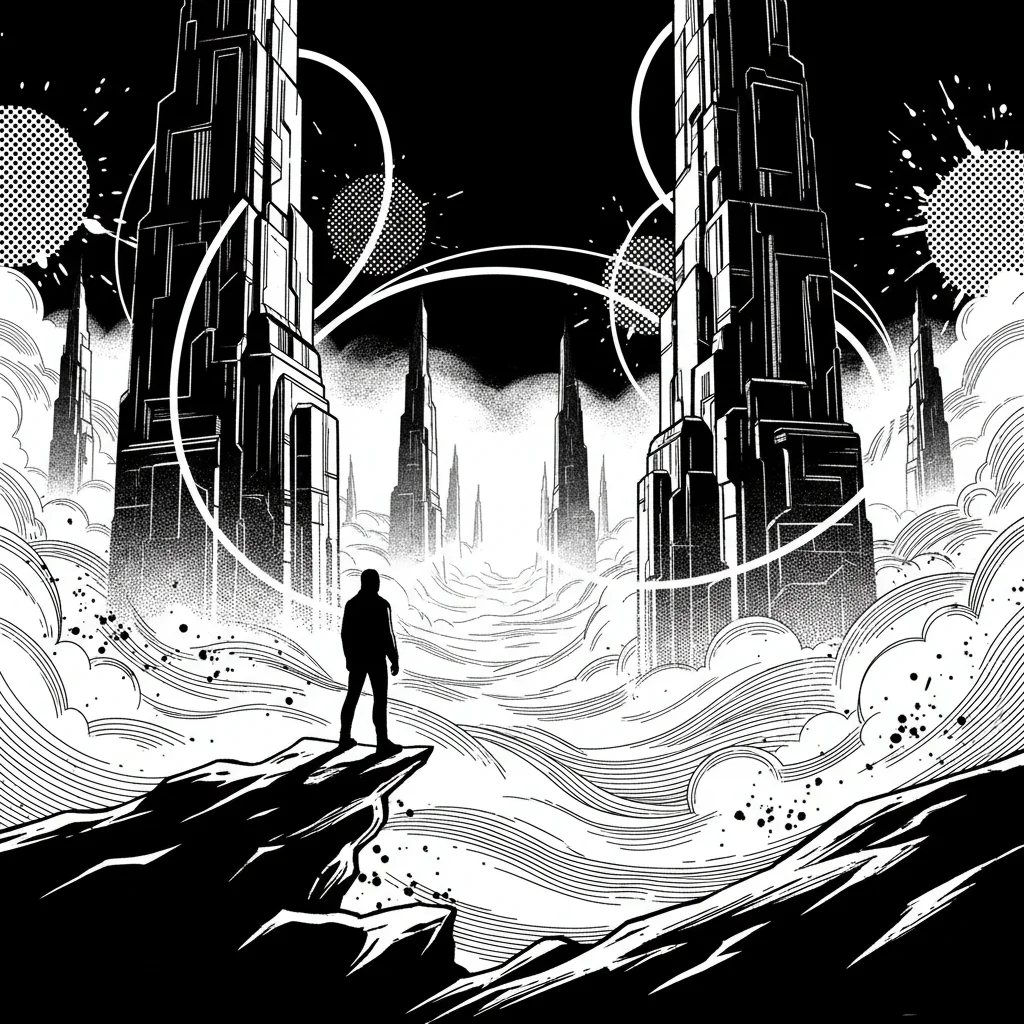

The Foundations of Visual Depth
The Horizon Line and Vanishing Point
Understanding how the horizon line and vanishing points dictate the perception of space is fundamental. Learn to use them to create a sense of realistic distance and volume, even in stylized settings. A good mastery of these elements allows for the construction of credible and immersive environments.
Scale and Proportion
The importance of the scale of elements in the scene is crucial for suggesting distance. Characters and objects further away should appear smaller and less detailed to reinforce the illusion of depth. Playing with the relative sizes of elements is key to guiding the reader's eye.
Clarity and Contrast
The decrease in contrast and clarity of background elements significantly contributes to the perception of depth. The subtle use of gradients and brightness variations simulates the effect of the atmosphere, making distant planes more hazy and less defined.
Explore Visual Depth
Learn the basics of perspective to build believable and immersive environments in your manga.
Discover the TechniquesMastering Atmospheric Nuances
The Color Palette for Depth
The impact of warm and cool colors on the perception of distance is undeniable. Colors tend to become bluer and more desaturated as they recede, creating a natural and visually pleasing sense of remoteness.
Using specific palettes, where cool hues dominate the horizon, reinforces this impression. This helps to clearly distinguish planes and give a sense of infinite space.
Lighting as a Tool for Depth
The direction and intensity of light can dramatically accentuate depth. The use of cast shadows and diffused light shapes forms and creates a palpable atmosphere, adding volume to scenes.
Well-thought-out lighting can direct the reader's gaze to specific points, while subtly blurring less important details in the background.
Refine Your Ambiance
Use color and light to bring your scenes to life and enhance emotion.
Master the AtmosphereIntegrating Atmospheric Perspective into Your Workflow
Framing and Choosing the Angle
Judicious framing and a well-chosen viewing angle can maximize the effect of atmospheric perspective. It is important not to saturate the composition with too much visual information to let the atmosphere breathe.
Experiment with different viewpoints to find the one that best communicates the desired depth and mood. A wide shot can emphasize immensity, while a low angle can give an impression of grandeur.
Managing Background Details
The art of simplifying details in distant areas is essential to avoid overloading the board. Focus on key elements that enhance the mood and depth without distracting the reader from the main action.
A minimalist approach to distant elements allows foreground subjects to stand out better and creates a clear visual hierarchy.
The Influence of AI on Mood Creation
AI tools can help generate textures, backgrounds, or lighting variations to quickly explore different atmospheric moods. This saves time in the ideation and iteration phase.
These technologies offer new possibilities to enrich your creations, while maintaining your artistic control over the overall direction and style.
Accelerate Your Creation
Discover how AI can help you quickly explore ideas and optimize your creative process.
Try Bulle.aiConclusion
Atmospheric perspective is a powerful technique for enriching your manga. By mastering these principles, you can create vaster, more immersive, and emotionally resonant worlds. Don't hesitate to experiment with these concepts to give a new dimension to your creations. To go further in optimizing your creative processes and generating visual ideas, discover how artificial intelligence can assist you in bringing your manga projects to fruition.