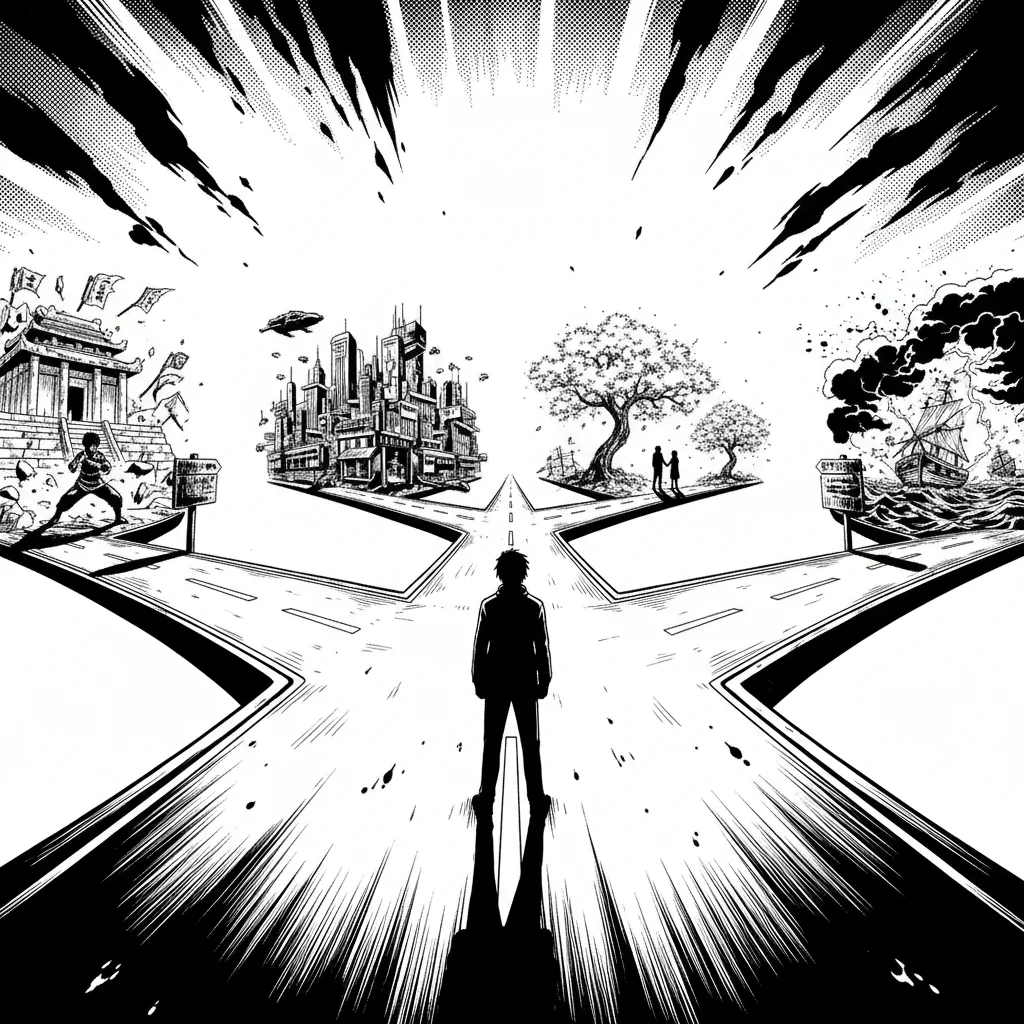

The Basics of Non-Linear Storytelling and Its Appeal
What is Non-Linear Storytelling?
Non-linear storytelling breaks the traditional chronological order of events. Instead of following an A -> B -> C sequence, it can present facts in a different order (B -> A -> C, for example), use flashbacks, flashforwards, nested narratives, or multiple points of view to construct the story. This approach allows for playing with the perception of time and revealing information progressively, thereby creating suspense or thematic depth.
Why Choose Non-Linearity in Manga?
Opting for a non-linear structure in manga can serve several creative purposes. It can create a sense of mystery, explore the consequences of events before showing them, or develop characters by revealing their past in a fragmented manner. It can also reflect the complexity of human memory or the chaotic nature of certain situations. For authors who wish to create their manga, it's a way to experiment and surprise the reader, pushing them to piece together the narrative puzzle.
Famous Examples of Successful Non-Linear Narratives
Several manga have brilliantly used non-linear storytelling to leave a lasting impression. Works like Erased (Boku dake ga Inai Machi) play with time travel to solve a mystery. Others, like The Flowers of Evil (Aku no Hana), use unconventional narrative structures to explore the complex psychology of their characters. These examples demonstrate that, when mastered, non-linearity can significantly enrich the reading experience.
Structure Your Narrative
Need help organizing your ideas and building a captivating narrative? Discover tools designed for creators.
Explore ToolsThe 5 Major Pitfalls of Non-Linear Storytelling
How can fragmentation harm coherence?
Excessive fragmentation of scenes or information can make it difficult for the reader to follow the main thread of the plot. Without clear links between fragments, the narrative risks appearing disjointed and losing its emotional impact. This mistake is particularly common when beginners are creating their manga.
When do a lack of temporal markers disorient the reader?
If time jumps are not accompanied by sufficient clues (visual, textual, or contextual), the reader can get lost, no longer knowing when the action is taking place. This harms immersion and understanding of the narrative stakes.
Why can excessive focus dilute the plot?
Focusing too much on secondary story arcs or peripheral characters, especially in a non-linear structure, can divert attention from the main plot. The heart of the narrative then risks becoming diluted, making the reading less engaging.
What is the risk of gratuitous complexity?
Introducing a non-linear structure for mere stylistic effect, without it truly serving the story's purpose or emotion, can prove counterproductive. Complexity that adds nothing to the story ends up tiring the reader.
How to avoid confusion of characters and narrative arcs?
In a non-linear narrative, it is crucial to clearly distinguish the different characters and their journeys. A clear presentation of who is who, and the evolution of each arc, is essential so that the reader does not feel overwhelmed by information.
Avoid Narrative Pitfalls
Don't let the complexity of your story detract from the reading experience. Learn to master non-linear storytelling.
Tips for AuthorsStrategies to Overcome the Pitfalls of Non-Linear Storytelling
To master non-linear storytelling and avoid pitfalls, a structured approach is essential. Here are concrete strategies to guide your readers through complex and captivating narratives when you want to create your manga.
- Establish a clear, even if implicit, internal timeline. Define for yourself the exact chronological order of events, even if you don't present it that way to the reader. This will serve as a solid narrative skeleton.
- Use visual and textual markers to guide the reader. Employ changes in graphic style, date or location indications, or distinct narrative transitions to signal time jumps or perspective shifts.
- Maintain a strong narrative thread despite jumps. Ensure that each scene, even if out of chronological order, contributes in some way to the main plot or the development of key characters.
- Simplify the structure when complexity adds nothing. If a narrative twist does not serve the purpose, do not unnecessarily burden your story. Clarity takes precedence over gratuitous complication.
- Ensure clarity of viewpoints and character arcs. Use narrative techniques to clearly distinguish narrators or characters whose point of view is presented, and follow their development consistently.
- Test the readability of your structure with beta readers. Before finalizing your manga, have outsiders read your structure to identify points of confusion and adjust if necessary.
Take It to the Next Level
Ready to transform your manga project into a coherent and well-structured series? Solutions exist to support you.
Discover Bulle.aiConclusion
Non-linear storytelling in manga is a powerful tool, but it requires rigorous mastery to avoid falling into the trap of confusion. By understanding potential pitfalls and applying clear structuring strategies, authors can harness the full potential of this approach to create memorable works appreciated by their readers. These techniques will help you create your manga with a solid and engaging narrative structure.