
Drawing three blocks before drawing a foot
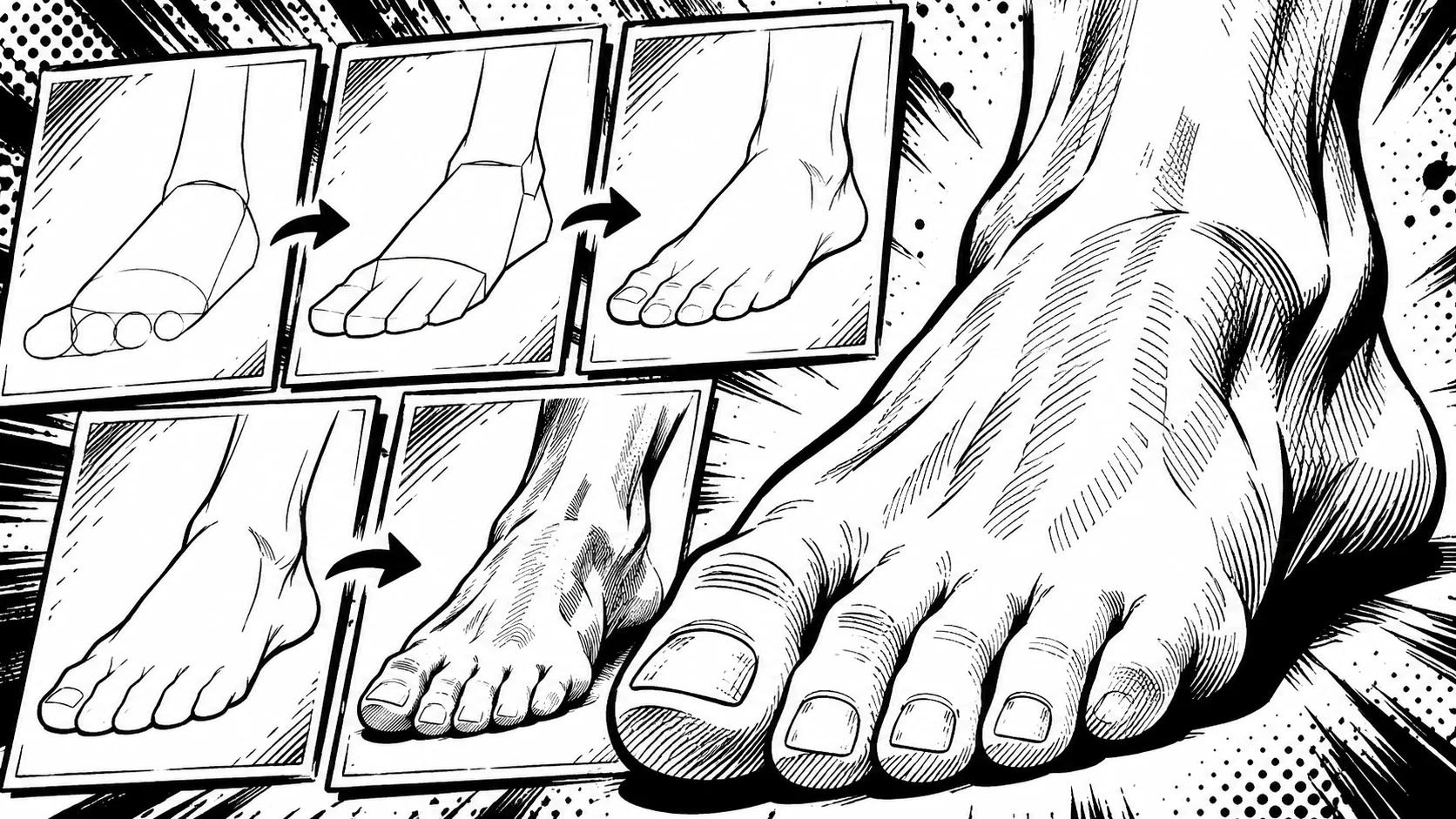
A foot boils down to three simple volumes: the heel, the arch, and the forefoot. First, place a rounded block for the heel, a long inclined block for the arch, then a wider and flatter block for the forefoot, which supports the toes.
These three blocks form a broken line when viewed in profile: the heel is low and round, the arch rises slightly, and the forefoot descends back toward the ground. It is this line that gives the foot its life. A foot drawn with a single continuous stroke looks like a stuffed sock.
Do not draw the toes at this stage. In a manga, they are almost always suggested, grouped into a single volume, with one line for the big toe and two or three short lines for the others.
Choosing the angle: profile, front, or perspective
The profile is the most readable angle. You can see the broken line of the three blocks, the ankle, and the length of the foot, which is roughly equal to the length of the character's head in classical proportions. It's the best angle for practicing.
From the front, the foot shortens. You only see the tip of the forefoot and the top of the ankle. Draw it like a small, wide wedge moving away from you, with the big toe on the inner side.
In perspective, from a three-quarter view, the closest block dominates. Draw it larger than the heel, then reduce the rest. If the character is walking toward the reader, the near foot can be almost twice as large as the one behind.
Placing the support: the foot must bear the weight
A believable foot is one that bears weight. Our Manga Addict posture guide gives the rule: draw a vertical line down from the hollow of the neck, and it should fall close to the supporting foot. If it falls into the empty space between the two feet, the character looks like they are about to fall or slip.
Apply this to the foot itself. The supporting foot is planted flat, with both the heel and forefoot on the ground. The free foot, on the other hand, lifts up: the heel rises, and only the forefoot still touches the ground.
For a running character, the back foot is on its toes, and the front foot touches the ground with its heel. For a standing character, both feet are flat, but never parallel: angle them slightly outward.
- Supporting foot: flat, beneath the vertical line of the neck.
- Free foot: heel raised, toes on the ground.
- Running foot: one heel lifting, one heel touching.
For the rest of the construction, see our guide on how to draw a manga body from all angles.
Dressing the foot: shoe, sandal, or bare foot
The shoe does not change the construction; it wraps around it. Always draw the three blocks first, then the shoe over them. A sneaker is a thickened arch block with a flat sole. A boot extends the ankle block upward. A sandal reveals the broken line and toes.
Keep the sole as a band of constant thickness beneath the three blocks. It is what gives the foot its place on the ground, and it must remain parallel to the ground even when the ankle bends.
For a bare foot, keep it simple: a line for the ankle, a line for the top of the foot, a grouped volume for the toes, and a ground-contact line that is thicker than the others.
Mistakes that make a foot float
The first mistake is a foot that is too small. An adult foot is roughly the length of a head. Below that, the character looks like they are standing on tiptoe for no reason.
The second is a foot facing forward when the body is in profile. The foot follows the axis of the leg: if the body pivots, the foot pivots with it.
The third is the absence of ground shadow. A thick line or an oval shadow beneath the foot is enough to anchor it. Without it, even a well-constructed foot floats.
The fourth is drawing all the toes. In a wide shot, no one is counting them, and they weigh the foot down.
- Foot shorter than a head.
- Foot facing forward on a profile body.
- No ground contact line.
- Five detailed toes in a wide shot.
Conclusion
A good manga foot is built in three blocks, given an angle, placed under the body's weight, and then dressed. Practice in profile first, then move on to perspective.
If you want to see these feet on real panels without drawing them yourself, Bulle.ai generates a complete manga project for 500 credits, and the Beginner pack at 19.90 € offers 2,000, which equals four projects. You can compare your drawing to a generated panel, and spot at a glance where the foot bears weight or floats.