Building the leg with two cylinders and a sphere
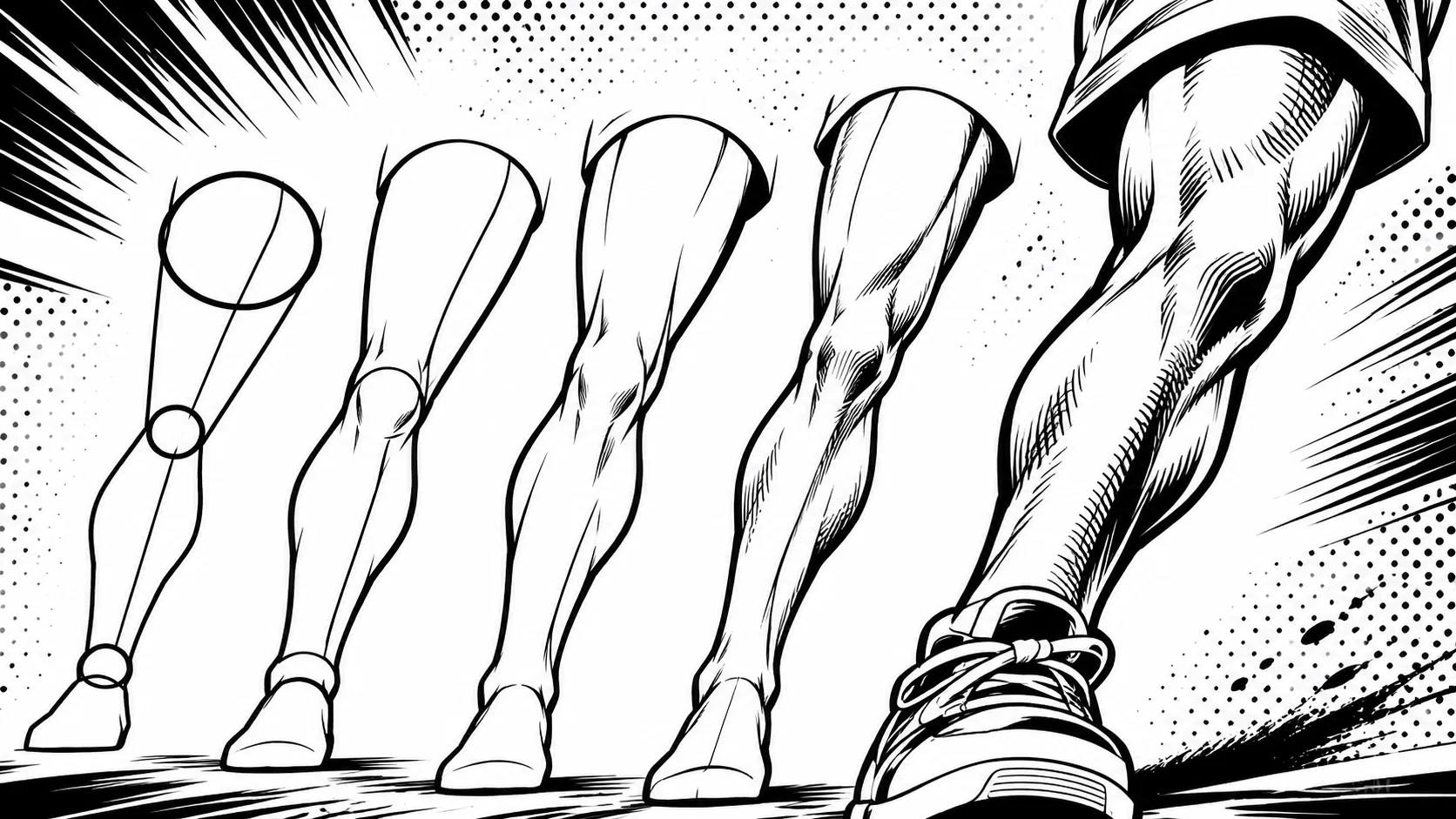
Forget the outline. Like the arm, the leg is built with two cylinders, the thigh and the calf, separated by a small sphere: the knee. This rule comes from our method to draw a manga body from all angles.
The thigh is the thickest cylinder, attached to the pelvis. The calf tapers toward the ankle. Do not draw the muscles yet: an overly precise outline freezes the leg before it even has a pose.
Keep one single idea: the leg is a lever. It starts from the pelvis, bends at the knee, and ends at the foot.
Finding the right leg length
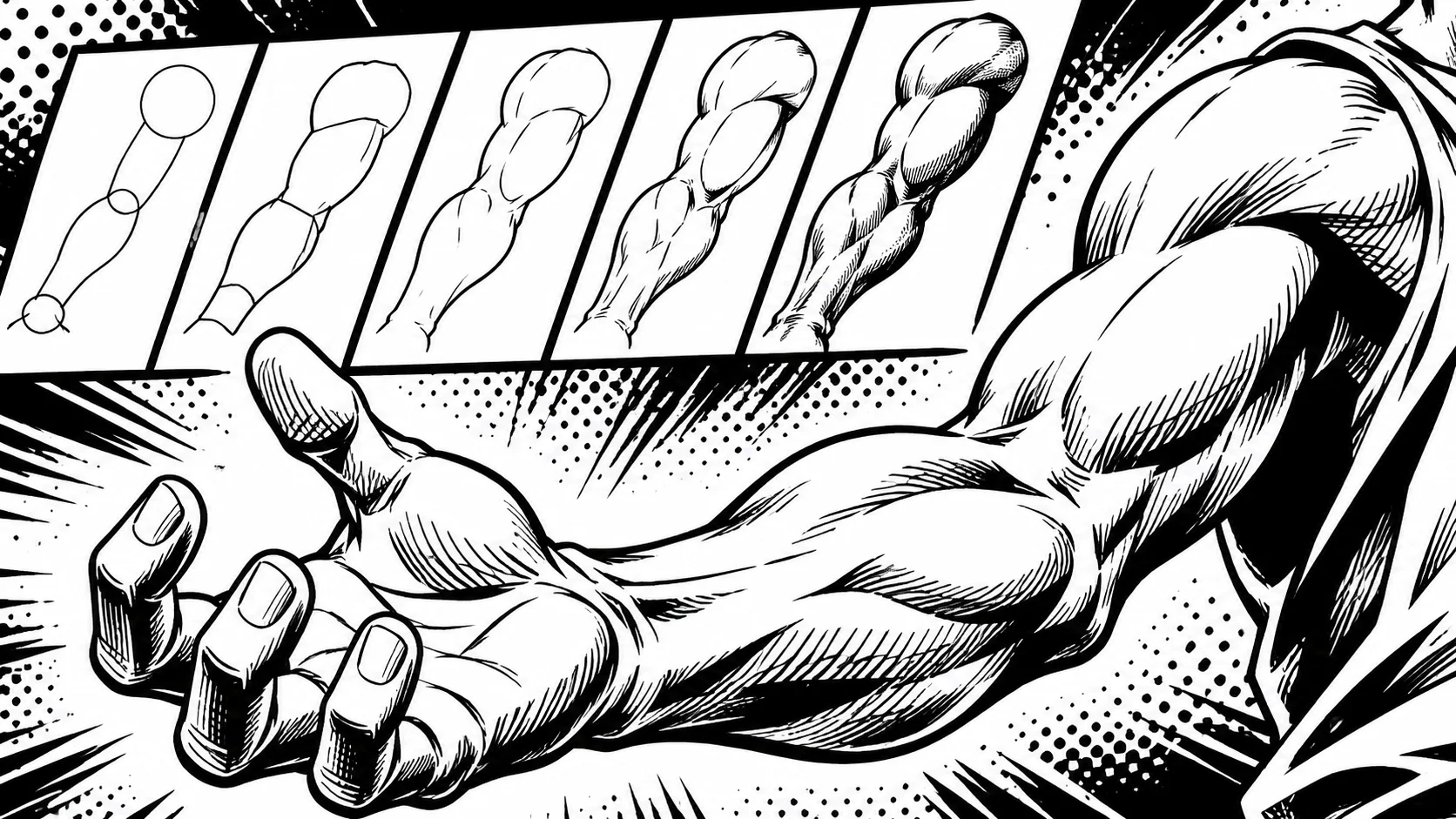
Most failed legs are too short because drawing stops too early. Use the arm as a reference: with the arm relaxed, the hand reaches down to the middle of the thigh, as explained in our article on the bras manga. If the hand reaches the knee, the leg is too short.
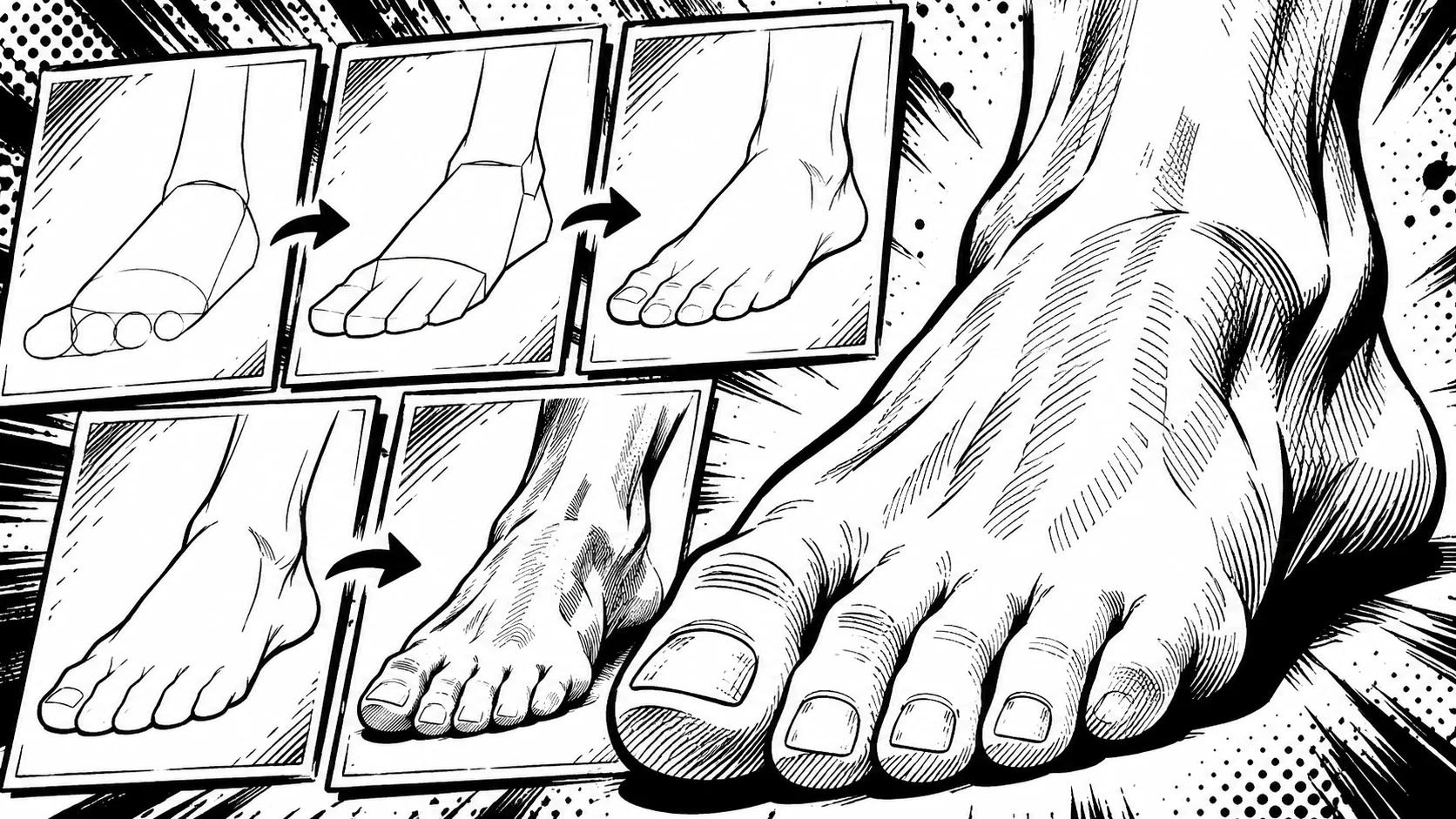
The foot serves as a second reference: an adult foot is roughly the length of one head, as detailed in the pied manga guide. If the foot is smaller, the leg looks like it is on tiptoe.
- Relaxed hand: middle of the thigh.
- Knee: mid-height of the leg.
- Foot: about one head long.
The manga style willingly lengthens the legs to give momentum to a character. Lengthen the calf and thigh together, never one without the other.
Bending the leg without breaking it
When the leg bends, both cylinders keep their length. Only the angle changes. The knee points forward, the calf goes backward, and the foot stays in line with the leg.
If you shorten the calf to show the crease, you get a doll's leg. Use perspective: the part coming closer to the reader looks wider, and the part moving away looks thinner.
For a sitting character, the thigh becomes almost horizontal. Draw it as a shortened cylinder pointing toward the reader, and check that the knee stays higher than the foot.
Placing the support: the leg must carry the weight
A believable leg carries something. Our posture manga guide gives the rule: draw a vertical line from the hollow of the neck, it must fall near the supporting foot. The supporting leg is almost straight, with the knee slightly bent. The free leg bends more and the heel lifts.
For a standing character, avoid two parallel legs: one supports, the other rests. This difference is enough to remove the mannequin's stiffness.
For a walking or running character, the back leg is extended on tiptoe and the front leg bends at the knee. The more dynamic the pose, the greater the gap between the two legs.
Mistakes that stiffen a leg
Five mistakes happen almost every time.
- A leg that stops too high: the character looks like a child in an adult costume.
- An identical thickness from the thigh to the ankle: the leg becomes a pipe.
- A missing knee: the leg bends in the middle of the calf.
- Two parallel legs: the pose is that of a mannequin.
- A foot that doesn't touch the ground: the character is floating.
Fill the leg in black: if the pose remains readable, the construction is good. Across a series of panels, the leg length must stay the same from one panel to another; Bulle.ai generates a complete manga project for 500 credits, which allows you to compare your drawing to a panel with stable proportions. The Beginner pack costs €19.90 for 2,000 credits, or four projects.
Conclusion
A manga leg is built with two cylinders and a sphere, with the right length, a bend that keeps proportions, and a support under the body's weight. Practice first on a standing pose, then on a sitting pose. To finish the lower body, move on to the pied manga, or see how Bulle.ai places whole characters on the panel.